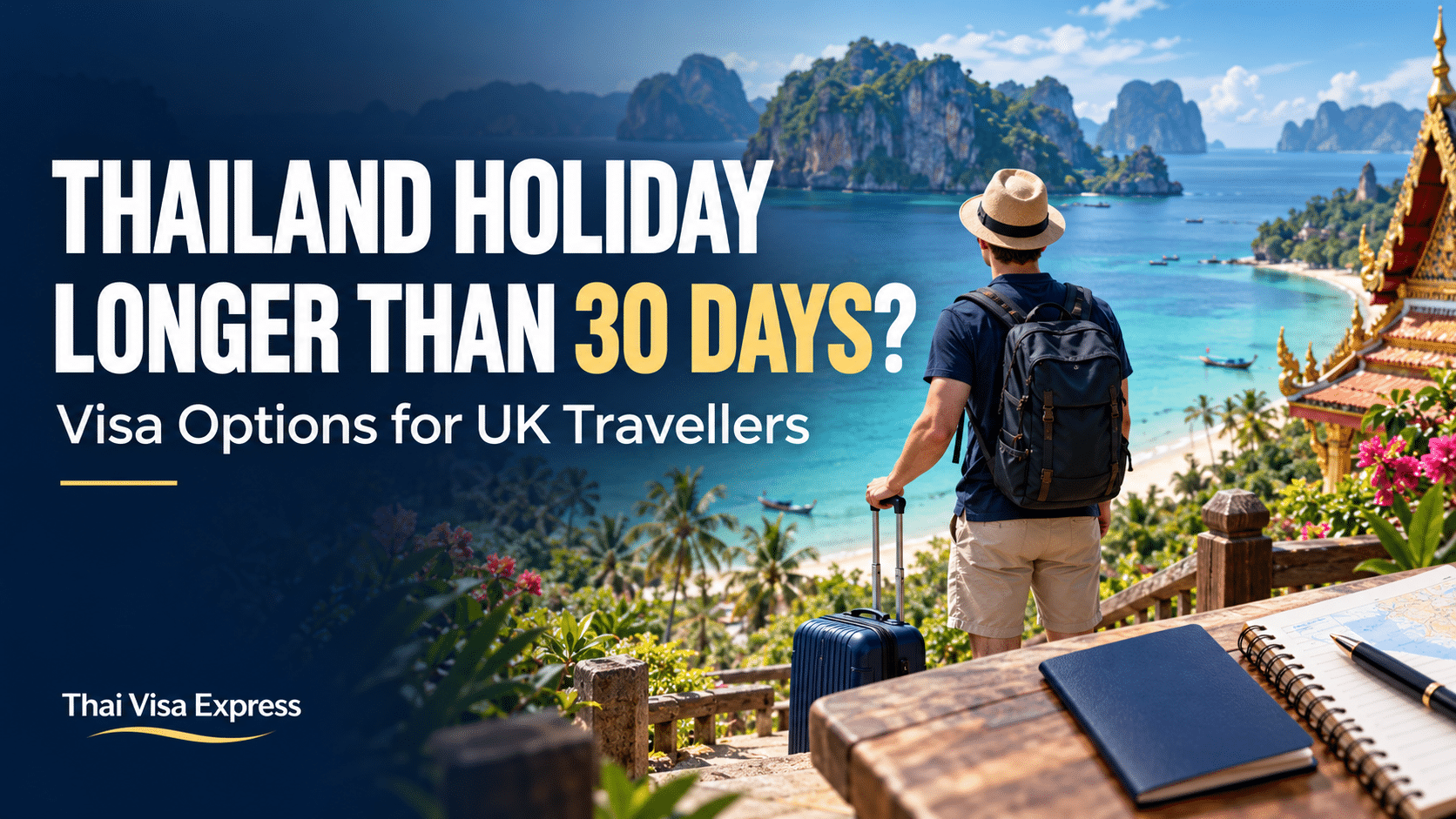
Planning a Thailand holiday longer than 30 days? If you are travelling on a British passport, check how your full itinerary fits the entry requirements before you fly. A five- or six-week holiday needs more planning than a short visit.
From 15 September 2026, the Royal Thai Embassy in London states that eligible British passport holders can enter Thailand for tourism without a visa for up to 30 days. Older articles referring to a 60-day visa exemption may therefore cause confusion.
Your main options for a longer holiday are to apply for a tourist visa before departure or, where eligible, request an extension after entering Thailand. These have different practical implications, particularly if your return ticket falls outside your initial permission to stay.
Last reviewed: 20 October 2026.
Need a Thailand tourist visa from the UK?
Send our Thailand team your nationality, travel dates and planned length of stay. Tell us whether you will enter Thailand once or make several visits. We can assess the appropriate application and confirm our service and charges.
WhatsApp our Thailand teamDo British passport holders need a visa for Thailand?
Eligible British passport holders visiting for tourism can use the visa-exemption scheme for a stay of up to 30 days, subject to meeting its conditions. Visa exemption means travelling without obtaining a visa beforehand; it is different from a Visa on Arrival.
If your planned holiday is longer, consider your arrangements before departure. Do not assume that the permission granted on a previous visit will apply to your next trip.
For a broader overview, read our guide: Do you need a visa to stay in Thailand?
Option 1: Apply for a tourist visa before travelling
A single-entry Thailand tourist visa normally allows a stay of up to 60 days from arrival, subject to the permission granted by Thai Immigration. This can suit a holiday lasting 35, 42 or 60 days.
For someone who already knows they want more than 30 days, applying before departure can avoid the need to spend part of the holiday arranging an extension simply to cover the original itinerary.
The application must meet the embassy’s requirements, and a decision should be obtained before travelling. Allow sufficient time for processing and any requests for further documents.
Read our Thailand tourist visa guide for UK applicants for single-entry and multiple-entry options.
Option 2: Enter visa-free and request an extension
Eligible visa-exempt visitors may request an extension of up to 30 days from Thai Immigration. Approval is discretionary: it should not be treated as guaranteed permission when planning your trip.
An extension involves an application in Thailand and supporting documents. Confirm the current requirements with the immigration office handling your application, and apply before your existing permission expires.
This option also requires you to consider the entry conditions and your airline’s boarding requirements before leaving the UK. An intention to apply for an extension later does not automatically resolve those requirements.
What if my return flight is after 30 days?
This is an important question for a 35- or 42-day holiday. The Royal Thai Embassy in London’s visa-exemption guidance requires proof of onward travel within the permitted stay.
If your only departure booking is outside that period, check the position before travelling. Your airline may ask you to demonstrate that you meet the applicable entry requirements.
Ask the airline what evidence it will accept for your itinerary. If you intend to remain in Thailand continuously for more than 30 days, a suitable tourist visa obtained before departure may be the more straightforward way to cover your planned stay.
Do not rely solely on someone else’s experience of being allowed to board without questions.
Which option fits my holiday?
| Planned holiday | What to consider |
|---|---|
| Up to 30 days | Visa exemption may suit eligible British tourists who meet all entry conditions. |
| 35 days | A tourist visa can cover the planned holiday without needing an extension solely for the extra five days. |
| 42 days / six weeks | Consider a tourist visa before departure. If relying on an extension, address onward-ticket requirements first. |
| Up to 60 days | A single-entry tourist visa may cover the trip, subject to the stay granted on arrival. |
| More than 60 days | Discuss the full itinerary. An eligible tourist visa holder may request an extension, but approval is separate. |
Do I need a multiple-entry tourist visa?
A longer holiday does not automatically mean you need a multiple-entry visa. The number of times you plan to enter Thailand matters as well as the total length of your trip.
If you will remain in Thailand throughout your holiday, a single-entry visa may be appropriate. If you plan to leave and return several times, discuss a multiple-entry option and the conditions applying to each entry.
A visa’s validity period is not the same as permission to remain continuously for that entire period.
Can I leave Thailand and return for more days?
Do not build your holiday around an assumption that a border trip will guarantee another admission. Each entry is assessed against the applicable rules and your circumstances.
For an ordinary longer holiday, compare a suitable visa before departure with an eligible extension in Thailand. That is usually a more useful starting point than planning an unnecessary journey solely to seek another entry.
Do not overstay to cover the extra days
There is no automatic allowance for a few extra holiday days. Check the permitted-stay date recorded by Thai Immigration and make suitable arrangements before it expires.
Overstaying can lead to fines and, depending on the circumstances, detention, deportation or an entry ban. Read our guide to being banned from Thailand: overstay rules and 10-year entry bans.
A 90-day address report does not extend your permission to stay. If you are planning a longer-term move, our Thailand 90-day reporting guide explains that separate procedure.
What if I am travelling for retirement or to visit Thai family?
A tourist visa is not necessarily the appropriate starting point for every longer stay. Eligible retirement applicants and people visiting qualifying Thai family may wish to consider a Non-Immigrant O visa.
Read our Thailand Non-O visa guide for UK applicants and tell us your purpose of travel before requesting an application.
Frequently asked questions
Can I stay in Thailand for 35 days without applying for a visa?
A 35-day itinerary exceeds the current 30-day visa-exempt stay for eligible British tourists. Although an extension may be available, you must also address the entry conditions and onward-ticket requirements before departure.
Is a Thailand visa extension guaranteed?
No. Thai Immigration decides whether to approve an extension. Apply before your current permission expires and provide the required documents.
Does my visa expiry date tell me when I must leave Thailand?
Not necessarily. Visa validity and your permitted stay are different. Check the stay granted by Thai Immigration on arrival and any later extension.
Should I use information saying British visitors receive 60 days visa-free?
Check the publication date and current official guidance. The Royal Thai Embassy in London states that the visa-exempt period for eligible British tourists changed to 30 days from 15 September 2026.
Plan your Thailand holiday before you fly
Whether you are visiting for five weeks, six weeks or longer, send us your itinerary. We can discuss tourist visa application assistance and explain the next steps.
Ask about a Thailand tourist visaRelated guides and discussion
- Thailand tourist visas: single and multiple entry
- Banned from Thailand: overstay rules and entry bans
- Thailand Non-O visa from the UK
- Forum discussion: what if my holiday is longer than 30 days?
Official information
General information only. Check current official requirements before booking or travelling. Visa decisions, extensions and admission are determined by the relevant Thai authorities. Thailand visa services are provided by our separate Thailand-based company.