Indefinite leave to remain (ILR) is settled status in the UK. It lets you live, work and study here without a time limit. The fees for ILR application are paid to the Home Office when you apply. The ILR application fee has been £3,226 per person since 8 April 2026, for adults and children alike, and you should not expect it back if you are refused. Add £50 for the Life in the UK test and, if you need one, an English test. A Thai spouse applying alone should budget £3,276 before the English test and any optional extras.
That headline fee is only part of the cost. This article shows what the Home Office charges, how the total grows for a couple or a family, which extras are compulsory and which are optional, and when you can and cannot get money back. It also explains how to avoid wasting the fee through avoidable mistakes. You will find worked examples you can copy for your own budget.
Thai Visa Express UK is an IAA-regulated office (registration number F200700163) that prepares in-country ILR and citizenship applications for people already living in the UK. Paul Aslett has worked as a UK immigration adviser since 2007. The government figures below come from the Home Office fee table, and you should confirm them on GOV.UK before you pay. The examples start with one Thai spouse applying for ILR in the UK. Their British partner is the sponsor, does not apply and pays no ILR fee.
Why the ILR application fee matters for your budget
The ILR fee deserves early planning because it is large, charged per person, paid in one go and not refundable if the application fails. It is usually the biggest single payment in the final stage of your immigration journey. A Thai spouse applying with two children pays £9,678 in application fees alone on the day they submit.
The fee is charged per person with no family discount
Every person who applies pays £3,226, including each child. There is no reduced child rate and no bundle price. Your British partner is not an applicant, so they pay no ILR fee. The table shows the application fees when a Thai spouse applies alone or with children, plus the £50 Life in the UK test for the adult. GOV.UK asks applicants aged 18 to 64 to pass that test.
| Who applies | Application fees | With Life in the UK test for the adult |
|---|---|---|
| Thai spouse alone | £3,226 | £3,276 |
| Thai spouse and one child | £6,452 | £6,502 |
| Thai spouse and two children | £9,678 | £9,728 |
You pay the full amount for every applicant when you submit, so have the money ready before you start.
Fees have risen every year
The ILR fee has risen every April for the last two years. The Home Office fee table shows each change.
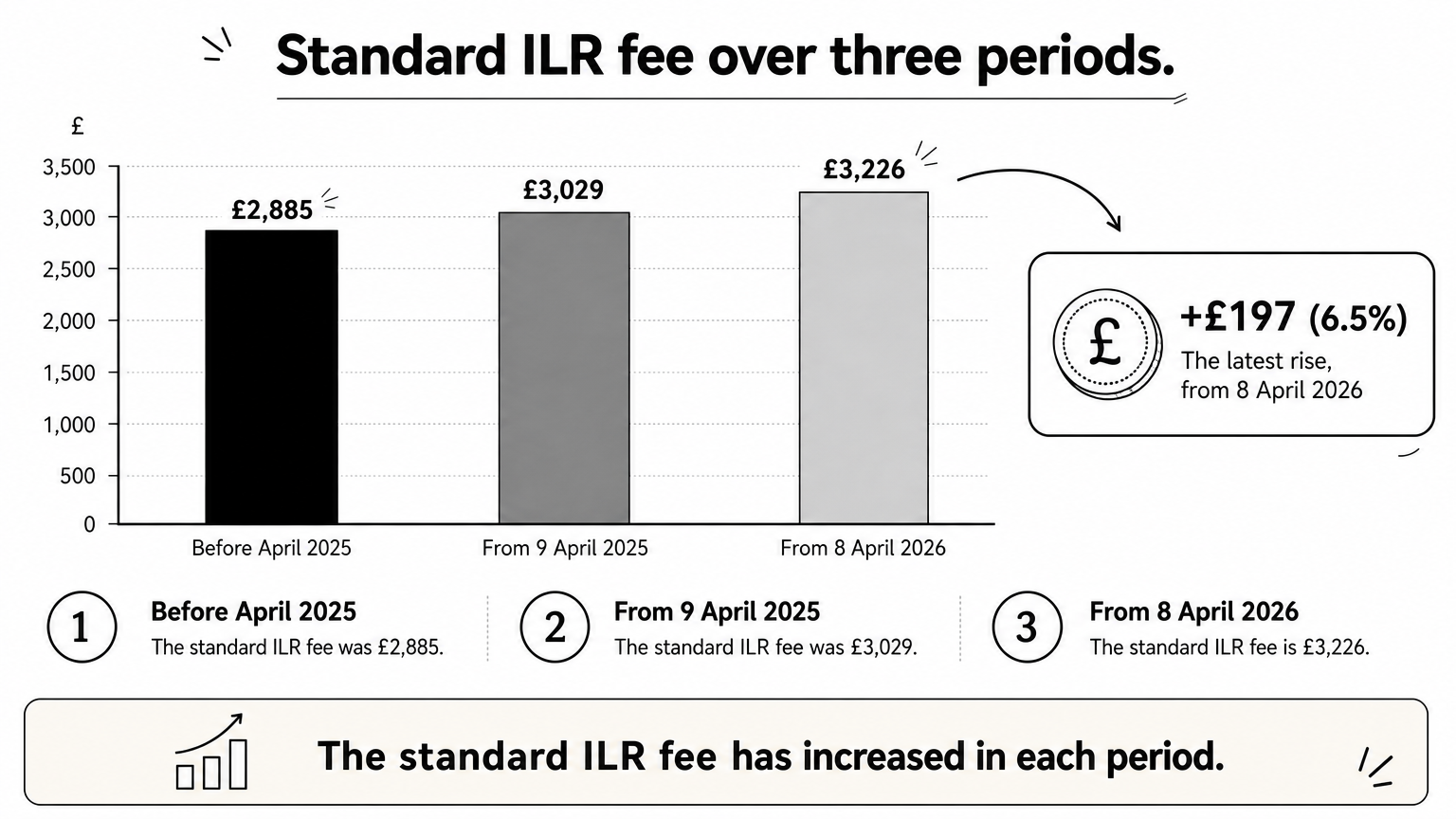
| Effective from | Standard ILR fee | Rise |
|---|---|---|
| Before April 2025 | £2,885 | n/a |
| 9 April 2025 | £3,029 | £144 (5%) |
| 8 April 2026 | £3,226 | £197 (6.5%) |
If you are close to your qualifying date, this pattern is a reason to be ready on time, not a reason to apply early. You can apply up to 28 days before you complete the qualifying period on a partner or parent family visa, and GOV.UK warns that an earlier application may be refused.
How to work out your total ILR cost
To calculate your total, multiply £3,226 by the number of applicants, then add your service level, tests, translations and any adviser fee. Do the sum before you book anything, because several extras depend on choices you can still make.
A step-by-step method
Work through these steps in order.
- Count everyone applying, including children, and multiply by £3,226.
- Decide whether you need a faster decision. Standard service costs nothing extra.
- Check who must sit the Life in the UK test and who needs an English test.
- List documents that need certified translation.
- Decide whether you want professional help with the application.
- Add a cushion of a few hundred pounds for retaking a test.
What each extra costs
This table sets the usual figures side by side. Prices for tests and translations vary by provider, so treat them as planning ranges.
| Cost | Amount | Notes |
|---|---|---|
| Standard decision | £0 extra | Usually a decision within 6 months of giving your fingerprints and photo |
| Super priority service | £1,000 per applicant | Usually a decision by the end of the next working day after you prove your identity |
| Life in the UK test | £50 | Applicants aged 18 to 64 |
| English language test (B1) | Set by the test provider | Not needed if you are exempt, for example with a degree taught in English |
| Certified translation | Set by the translator | Only for documents not in English or Welsh |
Super priority service is optional, and you can only choose it if you are eligible, so the application confirms what is on offer. The GOV.UK guidance on faster decisions gives usual timings, not guarantees, and each family member who applies pays the £1,000 too. The clock starts when you prove your identity, either at your biometrics appointment or when you finish the ID Check app upload, not when you submit the form.
The Immigration Health Surcharge is not charged when you apply for ILR, according to GOV.UK. You will already have paid it on your earlier visas. You would only pay it if you applied for ILR but were given limited leave instead. Our guide to the Immigration Health Surcharge covers the rates.
Two worked examples
Both examples include super priority service. The British partner does not apply and pays no ILR fee. For one Thai spouse, the sum is £3,226 in application fees, plus £1,000 for super priority, plus £50 for the Life in the UK test, plus an English test, which we assume costs £200 for illustration (your provider sets the real price). The total is £4,476.
Now add a child who applies with the Thai spouse. The child pays a further £3,226 and a further £1,000 for super priority, and sits no test. The total becomes £8,702.
Refunds, fee waivers and how you pay
The Home Office does not refund the ILR application fee if your application is refused. Waivers exist but are narrow, and payment is online and in full. Knowing these rules before you submit protects you from the costliest surprises.
When you can and cannot get money back
A refused application loses its £3,226 fee with no refund. If you travel outside the UK, Ireland, the Channel Islands or the Isle of Man while the application is pending, GOV.UK says the application will be withdrawn. You can cancel an application while you wait, but the fee is refunded only if you have not yet given your fingerprints and photo or, if you use the app, not yet confirmed your upload.
Super priority fees follow their own rules. GOV.UK says you will not get a refund if the application is refused, and you will not usually get one if the decision is late. The Home Office may refund it when the delay was outside its control, such as a technical problem. Test fees follow the rules of the test provider.
Fee waivers
A fee waiver is not a general discount, and the GOV.UK fee waiver service does not list ILR among the applications it covers. The fee waiver service covers applications for permission to stay on family or private life grounds, such as a partner or parent extension, plus some human rights, discretionary leave and trafficking cases. You must show that you cannot afford the fee, or that paying it would leave a child's needs unmet. The Home Office guidance says you do not have to be destitute.
Timing matters if you ask for a waiver. You make the request before you submit the application, and you send the application only after you get the decision. The Home Office guidance says your leave is protected under section 3C, whether the waiver is granted or refused, only if all of these apply: you had valid permission when you made the request, that permission expires before the request is decided, you submit a valid application within 10 working days of the decision, and it is the application the request was for. If your permission is close to expiring, take advice before you ask.
How payment works
You pay online when you submit, through the official GOV.UK application. Pay the full fee for every applicant at that point, and check the payment options the application offers.

Only pay through the official GOV.UK application. If a payment request reaches you any other way, stop and check GOV.UK.
How to avoid overspending on your ILR application
You protect your money mainly by being eligible on the day you apply and by submitting a complete application. Most expensive mistakes are errors of timing, evidence or absences, not errors in the fee sum.
Check your date, absences and evidence first
Confirm your qualifying date and your absences before you pay. The 180-day rule does not apply to every route. On a Skilled Worker visa, GOV.UK says you must spend no more than 180 days outside the UK in any 12 months. The Home Office continuous residence guidance applies that kind of test to work routes, the 10-year family route and long residence, and it does not list the five-year Appendix FM spouse or partner route. For that route, the GOV.UK partner page asks for 5 continuous years living in the UK on your family visa and states no 180-day cap. Long periods abroad can still cause problems, because you must show you have lived together and intend to carry on. List every trip and be ready to explain a long absence, whichever route you are on.
Gather payslips, bank statements, employer letters and passports in advance. If you apply on the partner route and your income evidence is the weak point, a financial document check can find gaps before you submit.
Watch for rule and fee changes
The qualifying period depends on your route. GOV.UK describes a 5-year, a 2-year and a 10-year route for partners, and the letter you got when your leave was last approved shows which one you are on. Check GOV.UK for the position on your route before you choose a submission date, because rules and fees can change.
If you plan to become a British citizen afterwards, budget separately. The citizenship application fee is currently around £1,839 including the ceremony fee, and you can check the latest figure in the Home Office fee table.
What professional help involves
You do not have to use an adviser, and plenty of straightforward cases are filed without one. If you do use one, check that they are regulated, ask for a fixed fee in writing, and remember that no adviser can guarantee a decision or a date. Thai Visa Express UK prepares in-country ILR applications. Our professional fee to process a standard ILR application is £995.
Home Office fees, tests, super priority service and translations are paid on top of our fee.
Budget for ILR before you apply
The ILR application fee is £3,226 per person from 8 April 2026, with no discount for children and no refund if you are refused. Your own total depends on how many people apply, whether you need a faster decision, which tests you must take and whether you want help. For one Thai spouse that is £3,276 once you add the Life in the UK test, plus an English test if you need one. Your British partner pays nothing.
Work the sum out before you submit, check your dates and absences, and pay only through GOV.UK. Applying for ILR from inside the UK and want a regulated adviser to handle it? Our IAA-regulated UK office offers a paid ILR application service, covering an eligibility check, evidence review and preparation of your application. Contact Thai Visa Express UK with your visa type, your expiry date and the date you first entered the UK on your family visa.