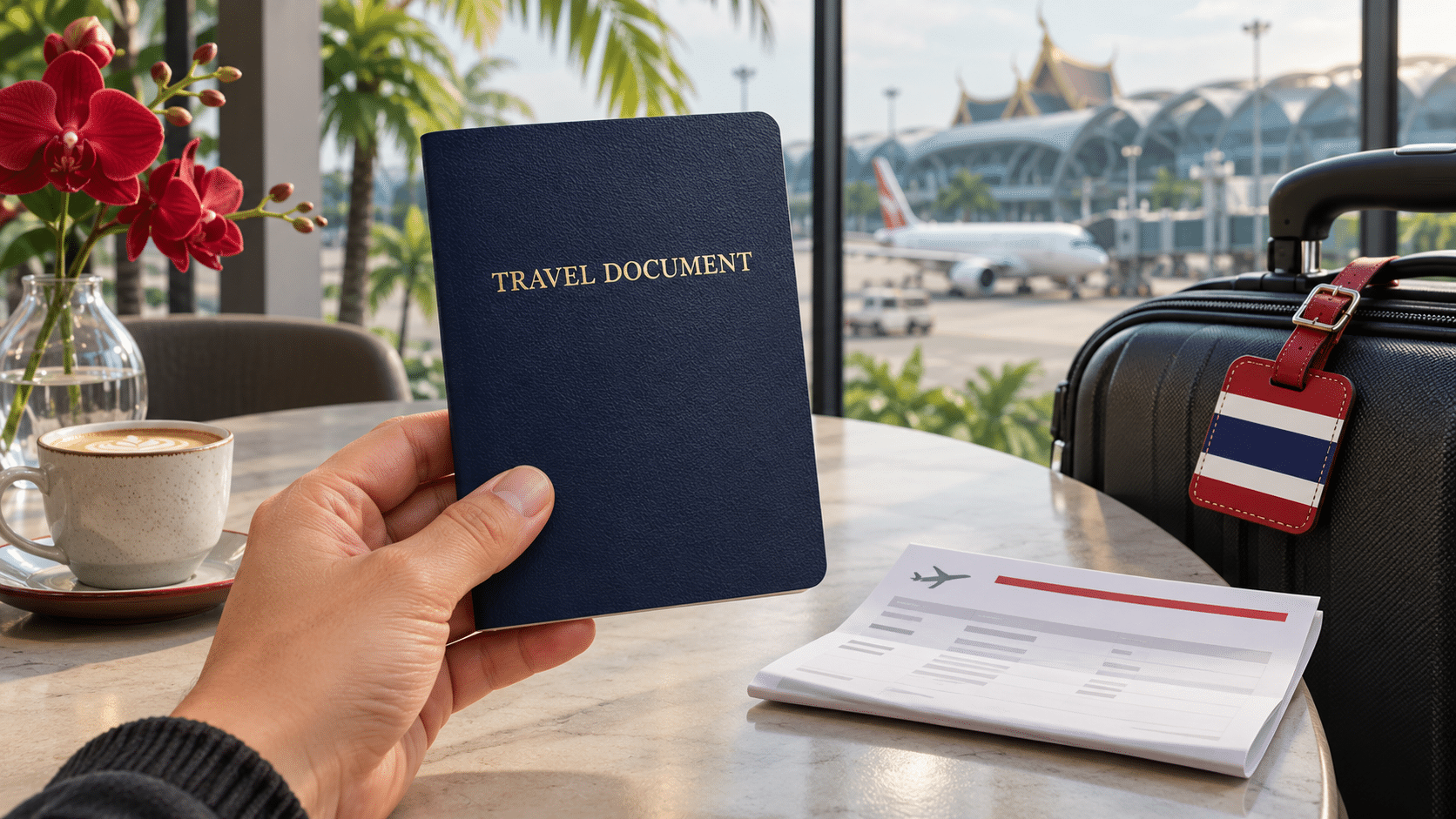
Thailand Non-O Retirement Visa from the UK
Thinking about retiring in Thailand? If you are aged 50 or over and planning to move from the UK, the Thailand Non-Immigrant O retirement visa may provide a route towards a longer stay.
Many British retirees choose Thailand for its warm climate, established expatriate communities, lifestyle and range of places to live, including Pattaya, Hua Hin, Chiang Mai and Phuket.
However, arranging a retirement visa involves more than simply completing an online application.
At Thai Visa Express, our Thailand-based team helps eligible UK residents prepare their initial Non-O e-Visa application before departure and arrange further retirement immigration assistance after arrival.
This guide explains the application process, financial requirements, supporting documents and steps involved in applying for a longer stay in Thailand.
Planning to Retire in Thailand?
Contact our Pattaya team about your initial Non-O visa and retirement extension options.
WhatsApp Our Thailand Visa TeamWhat Is a Thailand Non-O Retirement Visa?
The Non-Immigrant O retirement visa is a visa category for eligible people who intend to stay in Thailand for retirement purposes.
For applicants applying through the Royal Thai Embassy in London, the standard single-entry retirement category is intended for eligible pensioners aged 50 or over.
The initial visa normally permits a stay of up to 90 days following arrival in Thailand.
During that initial period, eligible applicants may prepare an application for an extension of stay based on retirement.
If approved, a retirement extension can allow a further period of up to one year, with subsequent annual extensions possible while the requirements continue to be met.
Important: A 90-day Non-O visa and a one-year retirement extension are two separate immigration applications. Receiving the initial visa does not guarantee that a subsequent extension will be approved.
Who Can Apply for a Non-O Retirement Visa from the UK?
Applicants must satisfy the requirements of the relevant Thai Embassy and demonstrate that their proposed stay is for an eligible retirement purpose.
The London Embassy describes its standard Non-O retirement category as being for pensioners aged 50 or above with a state pension.
Typical considerations include:
- Being at least 50 years old.
- Meeting the applicable retirement or pension eligibility requirements.
- Being physically outside Thailand when submitting the e-Visa application.
- Providing evidence of current location and relevant residence status.
- Meeting the required financial evidence threshold.
- Providing a valid passport and other supporting documents.
Being aged 50 or over does not automatically qualify someone for this particular category. Applicants without a state pension, or whose circumstances differ, should have their eligibility checked before applying.
Thailand Retirement Visa Financial Requirements
Financial evidence is an important part of the application process.
For the initial Non-O retirement application from the UK, the London Embassy publishes financial evidence thresholds of:
- 800,000 THB in available funds; or
- 65,000 THB per month in qualifying income.
The Embassy also publishes sterling equivalents for guidance, but exchange rates change. Applicants should check the current document instructions before submission.
Official bank statements and supporting evidence may be required. The London Embassy indicates that screenshots are not accepted in place of the required official bank statements.
Do You Need 800,000 THB in a Thai Bank Before Leaving the UK?
Not necessarily for the initial Non-O e-Visa application. The financial evidence provided for an application made through the UK differs from the bank documentation required for a later retirement extension inside Thailand.
However, applicants intending to use the Thai bank deposit method for their one-year retirement extension generally need to arrange an eligible account with a Thai bank after arrival and meet the required deposit and holding periods.
It is important to plan the timing of the deposit rather than leaving arrangements until the final weeks of the initial 90-day stay.
Documents Required for a Thailand Non-O Visa
The exact document checklist depends on the applicant's nationality, retirement circumstances and the Embassy's current requirements.
Typical evidence may include:
- Passport identification page.
- Recent passport-style photograph taken within six months.
- Evidence of current location in the UK, such as an appropriate utility bill or rental agreement.
- Official bank statements or qualifying financial evidence.
- Pension documentation where applicable.
- Additional evidence requested by the Royal Thai Embassy.
Thai Visa Express can provide an application checklist following an initial assessment of your circumstances.
We recommend avoiding incomplete, inconsistent or unclear documents, as these can lead to additional requests and delay the application.
How to Apply for a Thailand Non-O Visa from the UK
Thailand operates an electronic visa system, allowing eligible applicants to submit applications online before travelling.
Step 1 – Check Your Eligibility
Confirm that the Non-O retirement category is appropriate for your age, pension arrangements, residence and intended travel plans.
Step 2 – Prepare Your Documents
Gather the required passport details, photograph, financial documents and proof of current location.
Step 3 – Complete the Thai e-Visa Application
Submit the application through Thailand's official e-Visa system while outside Thailand and within the appropriate application jurisdiction.
You can read our step-by-step Thai e-Visa application guide for UK residents for further details.
Step 4 – Receive Your Visa Decision
The Embassy reviews the application and may request additional supporting documents.
Once approved, the e-Visa confirmation is provided electronically. Keep a copy available for travel.
Step 5 – Travel to Thailand
Enter Thailand during the visa's validity period. Check the permitted-until date recorded by Thai Immigration on arrival, as this determines your initial lawful stay.
A single-entry Non-O visa is normally valid for entry within three months of issue and permits an initial stay of up to 90 days.
What Happens After You Arrive in Thailand?
If your plan is to remain in Thailand for retirement, the initial visa is only the first stage.
Our Thailand team can discuss the arrangements needed for a retirement extension before you depart from the UK.
1. Arrange Your Thai Address Documentation
Depending on the service and location, you may need evidence of your residential address and other supporting immigration documents.
2. Arrange a Thai Bank Account
Applicants using the bank deposit route generally need an eligible account with a Thai bank in their own name.
Bank account opening is subject to the bank's identification, residency and compliance requirements. Approval cannot be guaranteed.
3. Transfer Your Retirement Funds
For the standard bank deposit method, retirement extension applicants generally need to maintain at least 800,000 THB in an eligible Thai bank account for the required period before applying.
The normal rule requires the funds to have been deposited for at least two months before the application, maintained for at least three months after approval, and not allowed to fall below 400,000 THB during the remaining period.
Alternative qualifying income and combined financial methods may be available, subject to the applicable documentary rules.
4. Apply for Your One-Year Retirement Extension
Once the relevant requirements have been met, an application may be submitted to Thai Immigration for an extension of stay based on retirement.
The extension application must be made while you still have valid permission to stay and within the locally permitted application period.
Approval is at the discretion of Thai Immigration.
5. Arrange a Re-Entry Permit if Required
After obtaining an extension, travellers who intend to leave Thailand and return should check whether a re-entry permit is required to preserve their existing permission to stay.
A multiple re-entry permit is useful for retirees who expect to make several overseas trips.
Remember that a re-entry permit does not extend the expiry date of your existing permission.
How Much Does Our Thailand Non-O Retirement Visa Service Cost?
Thai Visa Express offers assistance before departure and additional retirement support after arrival in Thailand.
| Service | Price |
|---|---|
| Initial Non-O e-Visa application assistance | 15,000 THB |
| Thailand retirement support package after arrival | 30,000 THB |
| Both stages combined | 45,000 THB |
The retirement support package includes assistance with Thai bank account arrangements, a one-year retirement extension application and a multiple re-entry permit, subject to eligibility and the agreed scope of service.
Before proceeding, we confirm the service quotation, payment terms and whether government charges or other expenses are included.
The required 800,000 THB bank deposit is the applicant's own financial requirement, not a professional service fee.
View our Thailand Non-O Visa application services and prices.
Non-O and Non-O-A Retirement Visas – What's the Difference?
Thailand has more than one immigration category available to eligible retirees.
| Feature | Non-O Retirement | Non-O-A Long Stay |
|---|---|---|
| Initial permitted stay | Up to 90 days | Up to 1 year |
| Minimum age | 50 | 50 |
| Application | Before travel through the applicable Embassy | Before travel through the applicable Embassy |
| Additional documentation | Category-specific retirement and financial evidence | Additional insurance, medical and police clearance requirements |
The Non-O-A category has different documentary requirements, including medical certification, police clearance and qualifying health insurance.
Applicants should not assume that the same requirements or procedures apply to both categories.
Our service focuses on helping eligible applicants with the initial Non-O route and, where suitable, a separate retirement extension application in Thailand.
Do You Need to Report to Immigration Every 90 Days?
Foreign nationals staying in Thailand for more than 90 consecutive days generally have a requirement to notify Thai Immigration of their current address at the applicable intervals.
This is commonly known as the 90-day report.
It is separate from an annual retirement extension and does not itself extend your permission to stay.
The reporting obligation depends on your actual period of continuous stay and the applicable Immigration rules.
Common Mistakes to Avoid
Retirement visa applications can become complicated when applicants misunderstand the distinction between their initial visa and their subsequent extension.
- Assuming that being over 50 automatically establishes eligibility for the London Non-O retirement category.
- Confusing a 90-day visa with permission to remain for a full year.
- Leaving Thai bank account arrangements until too late in the initial stay.
- Failing to maintain the required deposit for the necessary period.
- Travelling overseas without checking re-entry permit requirements.
- Allowing permission to stay to expire before applying for an extension.
- Confusing 90-day address reporting with annual visa extension requirements.
Planning ahead can help prevent avoidable problems and provide sufficient time to prepare the required evidence.
Frequently Asked Questions
Can I apply for a Thai Non-O retirement visa online from the UK?
Yes, eligible applicants can apply through Thailand's official e-Visa system while outside Thailand and within the relevant application jurisdiction.
Can I retire in Thailand at 50?
Thailand has retirement immigration categories for people aged 50 or over. However, applicants must satisfy the specific category requirements, including those published by the relevant Thai Embassy and Immigration Bureau.
Can I stay in Thailand for one year with a Non-O visa?
An initial single-entry Non-O retirement visa normally allows up to 90 days. A separate one-year retirement extension may be available after arrival if the applicant meets the relevant requirements.
Do I need to open a Thai bank account?
If you intend to use the bank deposit method for a one-year retirement extension, an eligible Thai bank account is normally required. Other financial routes may be available where the relevant evidence is accepted.
Can I leave Thailand and return during my retirement extension?
Yes, but you should ensure you have the appropriate re-entry permission before departure if it is required to preserve your current stay.
Can Thai Visa Express help with both stages?
Yes. Our Thailand company offers assistance with the initial Non-O application from overseas and a separate retirement support package after arrival, subject to eligibility and written agreement.
Get Help With Your Thailand Retirement Visa
If you are considering retiring in Thailand from the UK, we recommend reviewing your visa options and financial arrangements before travelling.
Thai Visa Express can help you understand the application stages, prepare the initial Non-O visa documentation and discuss the available assistance in Thailand.
When contacting us, please provide your nationality, age, pension status, intended travel date and whether you require only the initial visa or assistance with a retirement extension after arrival.
Start Your Thailand Retirement Visa Enquiry
Speak with our Pattaya-based team about Non-O visa applications, Thai bank account assistance and retirement extensions.
WhatsApp Our Thailand Visa TeamFor other visa categories and Thailand travel advice, explore our Thailand Visa Services Hub or read our Thailand Visa Services for UK Residents guide.
Information reviewed: 2 November 2026.
Thailand visa services are provided by Thai Visa Express Consultants Co., Ltd., a separate company based in Thailand that is not regulated by the UK Immigration Advice Authority (IAA).
Thai Visa Express is an independent application assistance provider and is not affiliated with the Royal Thai Embassy or Thai Immigration.
All visa applications, bank account arrangements, extensions and re-entry permits remain subject to the requirements and decisions of the relevant authorities. No visa outcome can be guaranteed.
Requirements and fees may change. Applicants can apply independently through the official Thai e-Visa system.
Official information: