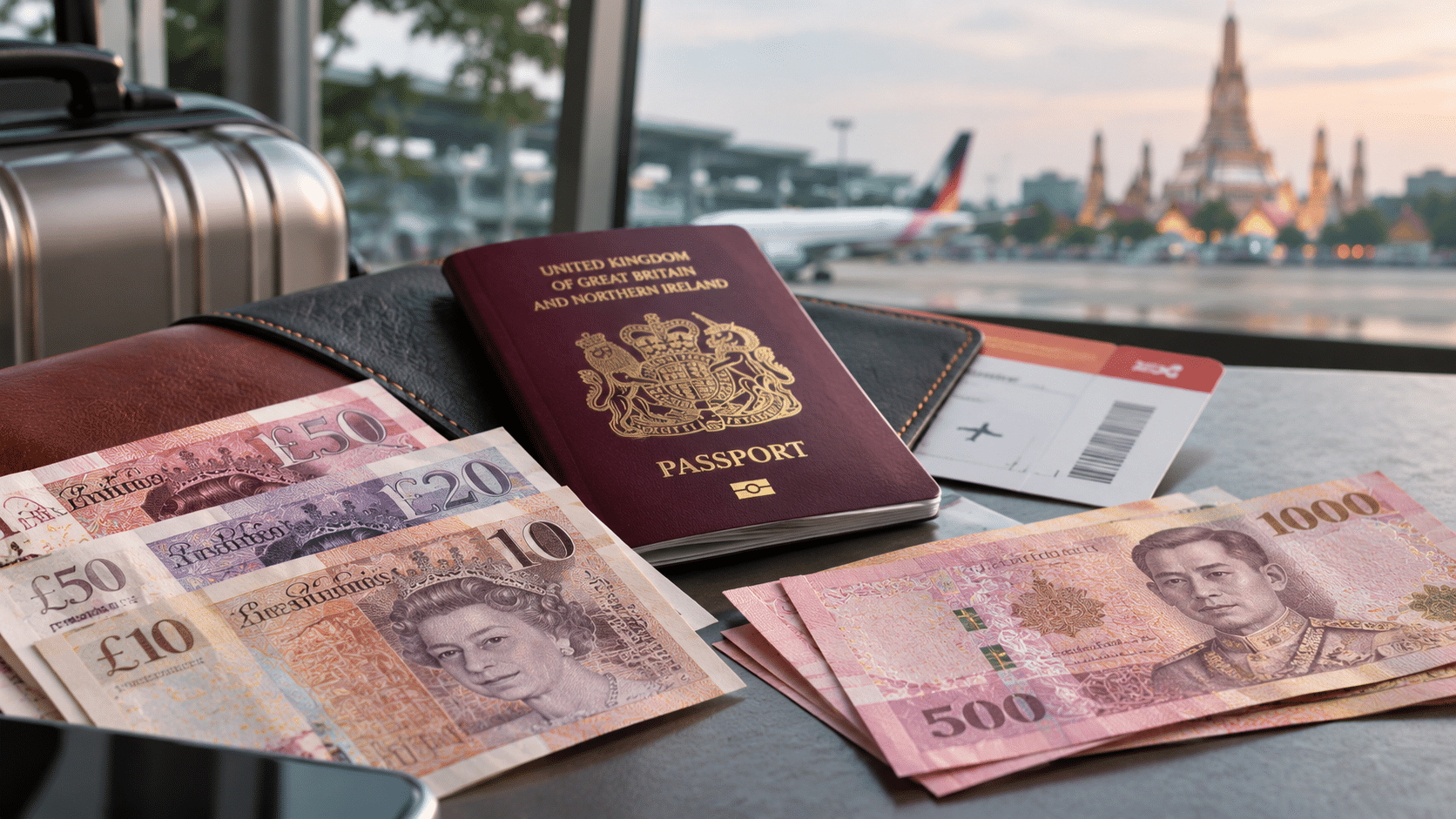
How much cash can you legally bring from the UK to Thailand? Whether you are visiting Thailand for a holiday, planning your retirement or moving permanently, it is important to understand the rules on travelling with cash.
Many British travellers believe there is a fixed maximum amount of money they can carry into Thailand. In practice, the rules distinguish between the amount you may carry and the amount you must declare to customs.
You must also consider the rules in the country you are leaving, not just those in Thailand.
In this 2026 guide, Thai Visa Express explains UK cash declaration requirements, Thai customs rules, currency exchange, proof of funds and practical considerations for travellers relocating to Thailand.
Thailand Essentials | Travel Money Guide
to Thailand in 2026
These figures refer to customs declaration requirements, not maximum permitted amounts. Separate rules apply to Northern Ireland and mixed-currency holdings.
Moving to Thailand from the UK?
Planning a long-term stay, retirement or repeated visits to Thailand?
Thai Visa Express provides professional assistance with Thailand visa applications, including Tourist, Non-O retirement and DTV routes.
Contact Thai Visa Express on WhatsAppWe provide visa application assistance. For financial transfers, tax advice or customs disputes, consult the appropriate specialist or authority.
1. How Much Cash Can You Take Out of the UK?
If you are leaving Great Britain (England, Scotland or Wales) for Thailand, you must declare cash of £10,000 or more to UK customs.
The requirement also applies where the total value in foreign currencies is equivalent to £10,000 or more.
It does not matter whether you are carrying British pounds, Thai baht, euros, US dollars or a combination.
Does the Limit Apply to Families?
Yes. HM Revenue & Customs explains that a family or group travelling together must make a declaration where the total cash carried is £10,000 or more, even where each individual is carrying less.
Example:
A couple travelling from London to Bangkok each carries £6,000 in cash.
Their combined total is £12,000. Under the UK rules for families and groups, a cash declaration is required.
What About Northern Ireland?
Different rules apply to travel between Northern Ireland and countries outside the EU, including Thailand.
The declaration threshold is €10,000 or more, or the equivalent in another currency.
Travellers departing from Northern Ireland should check the applicable rules for their exact journey, particularly if connecting through another country.
Does Cash Include Travellers' Cheques?
UK customs rules define cash more broadly than just banknotes and coins.
The definition includes certain bearer instruments, travellers' cheques and cheques signed without a named payee.
Additional categories apply under the Northern Ireland rules.
Read the official UK Government guidance on taking cash into and out of the UK .
2. How Much Cash Can You Bring Into Thailand?
Thailand generally permits travellers to bring foreign currency banknotes into the country without a fixed monetary maximum.
However, carrying larger amounts triggers mandatory customs declaration requirements.
According to the Bank of Thailand and Thai Customs guidance, foreign currency exceeding US$15,000 or the equivalent must be declared when entering or leaving Thailand.
The relevant value is calculated using the combined amount of foreign currencies being carried.
What If You Bring Thai Baht?
The published Thai rules also require a declaration when Thai baht banknotes exceed ฿450,000.
Combined holdings of Thai baht and foreign currencies may also trigger a declaration where their total exceeds the relevant ฿450,000 equivalent threshold.
This means you should consider all cash and relevant monetary instruments you are carrying, not only your British pounds.
Important 2026 guidance note:
Some older Thai government pages, and the Royal Thai Embassy in London's currency guidance, refer to a foreign-currency declaration threshold of US$20,000.
However, the Bank of Thailand and Thai Customs publish the lower US$15,000 figure, alongside the ฿450,000 mixed-currency threshold.
Travellers should follow the more cautious threshold and confirm the latest requirements directly with Thai Customs before carrying a large amount.
See the Bank of Thailand foreign exchange regulations .
3. UK and Thailand Cash Rules: A Quick Comparison
| Location | Declaration threshold | Important point |
|---|---|---|
| Leaving Great Britain | £10,000 or more | Family and group cash totals must also be considered. |
| Leaving Northern Ireland for a non-EU country | €10,000 or more | Separate Northern Ireland rules apply. |
| Entering Thailand with foreign currency | Over US$15,000 equivalent | Bank of Thailand and Thai Customs published threshold. |
| Entering Thailand with Thai baht | Over ฿450,000 | Mixed currencies may also trigger a declaration. |
Remember: You must independently satisfy the requirements of both the departure country and the arrival country.
A declaration made in Britain does not replace any declaration required on arrival in Thailand.
4. How Do You Declare Cash When Travelling to Thailand?
Step 1 – Calculate Your Cash Total
Add together the relevant banknotes, coins and other monetary instruments.
Convert foreign-currency amounts using an appropriate current exchange rate when checking the thresholds.
Step 2 – Make the UK Declaration Before Departure
If you exceed the applicable UK threshold, make your declaration through the official GOV.UK service.
The UK normally permits an advance declaration from 72 hours before the journey.
Keep the declaration reference and supporting documents accessible.
Step 3 – Check Transit Countries
If your journey involves a connection through another country, check whether separate cash declaration rules apply while transiting.
Rules differ according to the country, journey and whether you pass through customs.
Step 4 – Declare at Thai Customs When Required
On arrival in Thailand, approach Thai Customs through the Red Channel (Goods to Declare) when a declaration is required.
Tell the customs officer the amount and currencies you are carrying.
Follow the officer's instructions and retain any declaration documents provided.
5. Do You Need to Prove Where Your Money Came From?
Customs and financial institutions may ask questions about the origin and intended use of cash.
Carrying legitimate savings is not automatically unlawful. However, it is sensible to retain evidence showing how you obtained the money.
Useful Supporting Documents
- Recent bank statements showing the source and withdrawal of the funds.
- Bank withdrawal receipts.
- Employment or business income records, where relevant.
- Evidence of pension or retirement income.
- Documents relating to a property sale or other significant transaction.
- Copies or references for any customs declarations.
The appropriate evidence depends on your circumstances.
UK cash declaration forms ask for information about the source of the funds and their intended use.
A Thai bank may separately ask for identification and evidence of the origin of funds before accepting a substantial cash deposit.
Does Declaring Cash Mean You Have to Pay Tax?
A cash declaration is not, by itself, a tax assessment.
It is a customs reporting obligation intended to record cross-border movements of money.
However, any applicable tax treatment depends on factors such as residence, the source of the money, its nature and the relevant tax laws.
People moving to Thailand or transferring substantial assets should obtain appropriate UK and Thai tax advice where needed.
6. Should You Bring British Pounds or Exchange Them Before Travelling?
British travellers have several ways of accessing money in Thailand.
British Pound Banknotes
You may be able to exchange GBP banknotes at an authorised Thai bank or money changer. Rates and acceptable note conditions vary.
Thai Baht Before Departure
Having some Thai baht available on arrival can help with initial travel expenses. Check the exchange rate and any fees.
Debit and Credit Cards
Cards reduce the need to carry large amounts of physical cash, although foreign transaction and ATM fees may apply.
Bank Transfers
For larger sums, a regulated bank transfer or authorised money transfer provider may provide a clearer transaction record than transporting cash.
Is It Better to Exchange Money in the UK or Thailand?
There is no single answer.
The best outcome depends on the exchange rate, fees, availability and your circumstances at the time.
Compare the final amount of Thai baht you would receive, not just the advertised exchange rate.
For large amounts, security and documentation may matter more than a small difference in rates.
7. Bringing Money to Thailand for Retirement
British nationals retiring in Thailand sometimes need access to significant funds for accommodation, living expenses, health insurance and visa arrangements.
However, carrying large amounts of cash is not necessarily the most practical way to arrange retirement finances.
A regulated international bank transfer may provide a clearer record of the origin and movement of money.
What About the Thailand Non-O Retirement Visa?
Thailand has different retirement visa categories with different financial, insurance and documentary requirements.
If you are considering retirement, read our Thailand Non-O-A Retirement Visa and Health Insurance Guide .
For people considering longer-term arrangements, our Thailand Non-O-X 10-Year Retirement Visa Guide explains the separate 5+5-year scheme and its substantial financial requirements.
Our established Thailand Non-O visa service covers a different, standard retirement route.
Visa requirements and customs rules are separate.
Being allowed to carry money into Thailand does not mean that the same cash automatically satisfies the financial requirements for a retirement visa.
Equally, the amount of money you carry through an airport is not the same thing as the amount you must demonstrate under a particular visa application.
What If You Are Buying a Condominium?
If you intend to buy a condominium in Thailand, check the rules governing the source and transfer of funds before moving large sums of money.
Foreign purchasers may need bank evidence showing how purchase funds entered Thailand.
Using physical cash without planning the documentation requirements may create problems.
Seek advice from the receiving Thai bank and a qualified Thai property lawyer before transferring purchase funds.
8. Is Carrying Large Amounts of Cash into Thailand Safe?
Even where a cash amount can legally be transported, there are practical risks.
- Cash can be lost or stolen during travel.
- Travel insurance may provide only limited cash protection.
- Airport security and customs officials may ask questions about unusual amounts.
- Exchanging or depositing large quantities of banknotes may require additional documentation.
- A customs declaration does not guarantee that a bank will accept the funds as a deposit.
For a substantial transfer, compare the security, costs and documentation of regulated banking options before deciding to travel with cash.
9. What Happens If You Fail to Declare Cash?
Failure to comply with mandatory customs declaration rules can have serious consequences.
In the United Kingdom
HMRC warns that undeclared cash may be seized.
A penalty of up to £5,000 may apply for failing to make a required declaration.
Customs may also seize cash where there are reasonable grounds to suspect criminal activity, regardless of amount.
In Thailand
Failure to declare cash above the applicable Thai threshold, or making an incorrect declaration, may lead to enforcement action.
Consequences depend on the circumstances, but can include seizure, financial penalties or investigation.
If you are uncertain whether a declaration is required, contact Thai Customs before travelling.
10. Can Carrying Too Much Cash Affect Entry to Thailand?
Carrying money is not, by itself, a reason that a genuine tourist must be refused entry.
However, immigration eligibility and customs compliance are two different matters.
Immigration officers may question the purpose of a visit, and customs officers may ask about the money being carried.
Frequent visitors should also understand that carrying sufficient cash does not guarantee entry.
Our related guide, Refused Entry to Thailand Because of Too Many Visits , explains repeated visa runs, immigration scrutiny and what to do after a refusal.
11. Frequently Asked Questions
Can I Take £20,000 in Cash to Thailand?
Potentially, yes, if the funds are lawful and all applicable declaration requirements are followed.
The amount would exceed the UK declaration threshold when departing Great Britain.
It would also ordinarily exceed Thailand's published foreign-currency declaration threshold, depending on the relevant exchange rate.
Check all requirements before travel.
Can I Carry £9,000 Without Declaring It?
The Great Britain declaration threshold is £10,000 or more, but you must consider other currencies and any family or group cash total.
Thailand applies separate thresholds, so the full journey must be assessed.
Can My Wife Carry Half the Money?
The UK rules expressly cover families and groups travelling together.
Splitting cash between family members does not automatically remove the obligation to declare.
The ownership and purpose of funds must be represented truthfully.
Do I Pay Tax for Bringing Savings into Thailand?
Not simply because you submit a customs cash declaration.
Separate tax rules may apply to particular income or remittances, depending on residence and the circumstances.
For substantial sums, seek qualified tax advice.
Can I Bring More Than US$15,000 into Thailand?
Thailand generally allows foreign-currency banknotes to be imported without a fixed maximum, provided applicable customs rules are followed.
The US$15,000 figure is a declaration threshold, not a general prohibition.
What If I Have Both Pounds and Thai Baht?
Combined holdings may trigger a Thai customs declaration even if neither currency on its own appears to exceed a threshold.
Check the total equivalent value.
Can I Put the Cash Straight into a Thai Bank?
That depends on the bank's requirements, your identification, account eligibility and any requested source-of-funds evidence.
A customs declaration does not guarantee a bank deposit will be accepted.
Is a Bank Transfer Better Than Cash?
For large sums, a regulated transfer is often worth considering because it can reduce physical security risks and provide transaction records.
Compare fees, exchange rates and documentary requirements.
Where Can I Find Thailand Visa Costs?
Our guide to Thailand Visa Costs from the UK in 2026 explains common visa categories, government fees and professional application assistance.
12. Final Advice for British Travellers
Bringing cash from the UK to Thailand is generally lawful, but travellers must understand the declaration rules in both countries.
The most important points are straightforward:
- Declare £10,000 or more when leaving Great Britain, including the relevant family or group total.
- Apply the separate €10,000 Northern Ireland threshold where relevant.
- Check Thai Customs requirements carefully, especially the US$15,000 and ฿450,000 declaration thresholds.
- Retain proof of the source of significant funds.
- Consider regulated bank transfers rather than carrying large amounts of physical cash.
If you are moving to Thailand for retirement, ensure your financial arrangements also meet the requirements of your intended visa route.
Planning to Live or Retire in Thailand?
Thai Visa Express assists eligible applicants with Thailand visa applications and retirement visa services.
We can explain our available Non-O, Tourist and DTV application services.
WhatsApp Thai Visa ExpressThailand visa services are provided by Thai Visa Express Consultants Co., Ltd., our separate Thailand-based company.
Independent visa application assistance. We are not HMRC, Thai Customs or the Bank of Thailand.
Explore More Thailand Essentials Guides
Planning a trip, retirement or longer stay in Thailand? Read our related guides covering entry requirements, retirement visas and visa application costs.
Information reviewed: 3 November 2026.
Currency declaration requirements, foreign exchange rules and customs procedures may change. Check the current rules before travelling.
Official references:
- UK Government – Taking Cash Into and Out of the UK
- Bank of Thailand – Exchange Control Regulations
- Thai Customs – Currency Declaration Requirements
- Royal Thai Embassy London – Bringing Currency Into and Out of Thailand
Note: Thai official sources currently contain differing foreign-currency declaration thresholds. This article uses the lower US$15,000 figure published by the Bank of Thailand and Thai Customs.