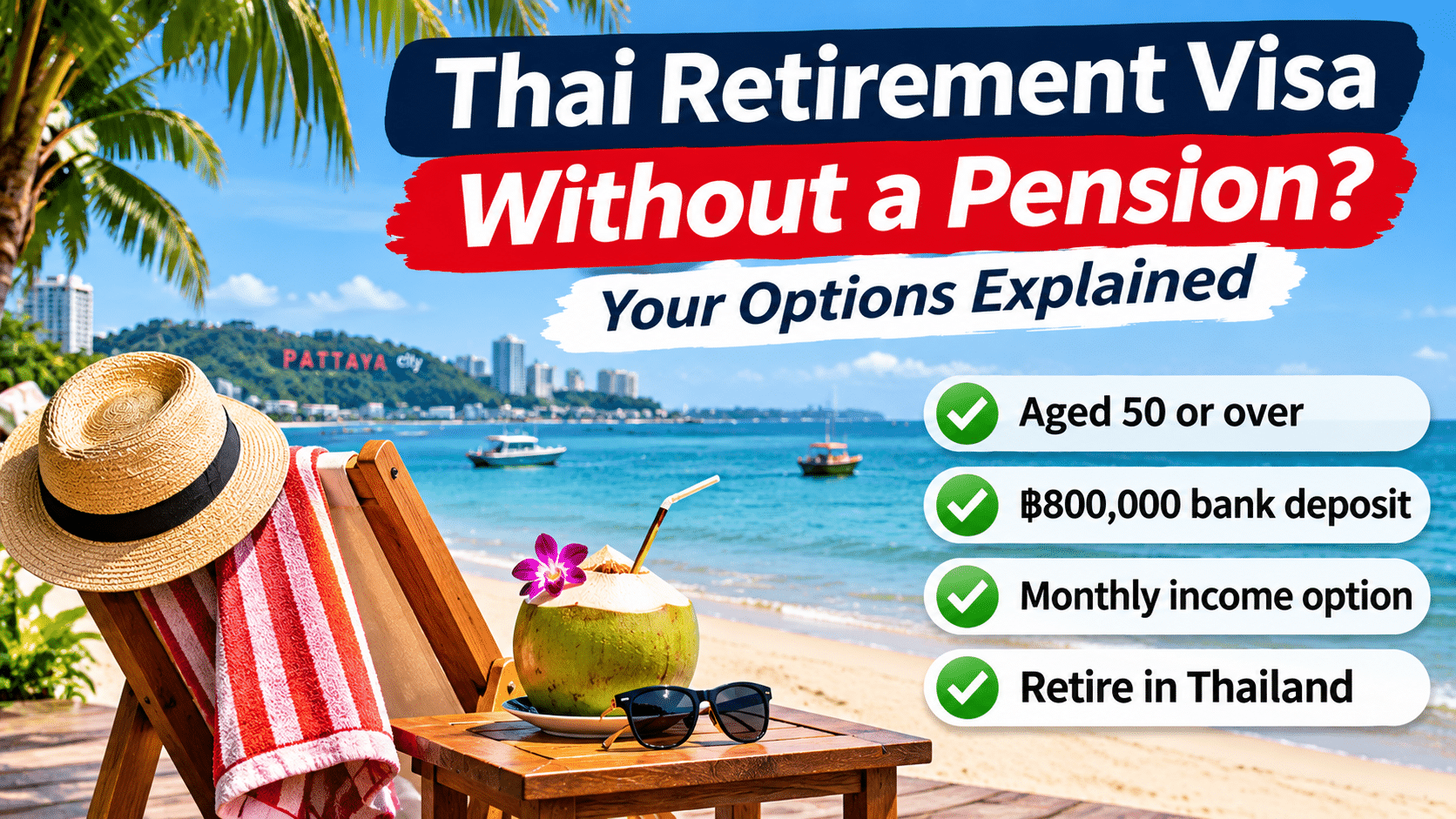
Can you retire in Thailand without receiving a pension? Yes, potentially. British nationals aged 50 or over may qualify for a retirement-based extension of stay in Thailand by meeting the financial requirements through savings rather than pension income.
Many people considering retirement in Thailand have savings, investments or proceeds from selling their UK property, but have not yet reached State Pension age.
The good news is that receiving a UK State Pension is not a universal requirement for retirement-based permission to stay in Thailand.
However, there is an important difference between obtaining an initial Thai visa from the United Kingdom and applying for a one-year retirement extension through Thai Immigration.
This guide explains the options available in 2026.
Retiring in Thailand Without a Pension?
Are you aged 50 or over with sufficient savings? Our Pattaya-based visa team can explain your retirement visa options and the financial requirements.
Chat With Our Thailand Visa Team on WhatsAppThai Visa Express Consultants Co., Ltd. – Pattaya, Thailand
Do You Need a Pension for a Thai Retirement Visa?
No, not necessarily. For the standard one-year retirement extension in Thailand, eligible foreign nationals aged 50 or over can normally meet the financial requirements using a qualifying Thai bank deposit or acceptable income evidence.
Thai Immigration generally recognises the following financial methods:
- Thai bank deposit: At least 800,000 THB maintained in a qualifying Thai bank account in accordance with the required timing and balance rules.
- Monthly income: At least 65,000 THB per month, supported by acceptable evidence.
- Combination method: A qualifying combination of annual income and bank savings amounting to at least 800,000 THB, subject to the applicable immigration requirements.
Not every immigration office handles financial evidence in exactly the same way, and not every form of income or combination evidence will necessarily be accepted.
For applicants who do not receive a pension, the Thai bank deposit route is often the clearest option to investigate.
Can You Apply for a Non-O Retirement Visa From the UK Without a Pension?
This is where applicants must be careful.
The Royal Thai Embassy in London describes its Non-Immigrant O retirement visa category as intended for pensioners aged 50 or over who receive a State Pension.
The Embassy also publishes financial evidence requirements involving income or savings, but meeting a financial threshold does not necessarily remove the pensioner eligibility condition stated for that particular application category.
Therefore, a British national aged 50 or over who has savings but receives no pension should not assume that an initial Non-O retirement e-Visa application will automatically be accepted.
Depending on the individual's circumstances, another lawful entry route followed by an appropriate in-country immigration application may be available.
Read our main guide to the Thailand Non-Immigrant O retirement visa for further details.
The 800,000 Baht Thai Bank Account Option
For many British nationals who do not receive pension payments, the 800,000 THB Thai bank deposit method provides a potential route to obtaining and maintaining a one-year retirement extension.
The standard financial requirements generally include:
- The applicant must be aged 50 or over.
- The applicant must hold an appropriate Non-Immigrant immigration status.
- At least 800,000 THB must normally be held in a qualifying Thai bank account for at least two months before the retirement extension application.
- The account must maintain at least 800,000 THB for three months after the extension is granted.
- After that period, the account balance must not fall below 400,000 THB during the applicable remaining period.
Applicants must also provide acceptable bank evidence, comply with the applicable immigration procedures and continue to meet the financial requirements for subsequent extensions.
The account requirements for obtaining or changing to the initial Non-O status inside Thailand can differ from those for the annual extension.
Can You Retire in Thailand Before UK State Pension Age?
Yes, potentially.
Thailand's standard retirement immigration age is 50, which is considerably younger than the UK State Pension age for many British nationals.
For example, consider a British national aged 55 who has sold a property in the United Kingdom and has sufficient savings to fund retirement.
Even if this person does not yet receive a State Pension or private pension, they may qualify for a Thai retirement extension using the bank deposit method, provided the other immigration requirements are satisfied.
The appropriate initial visa or immigration status must still be arranged.
Can You Use Savings Instead of Pension Income?
Yes, when relying on the qualifying Thai bank deposit method for a retirement extension.
The source of the savings may include legitimate funds such as:
- Proceeds from selling a property in the UK.
- Accumulated personal savings.
- Investment proceeds.
- Inheritance funds.
- Other legitimate capital.
Applicants should retain appropriate evidence of the source and transfer of funds, particularly where requested by their bank or the relevant immigration authorities.
Having sufficient savings is not, by itself, a guarantee of visa approval.
Do You Need a Thai Bank Account?
If you intend to use the 800,000 THB Thai bank deposit method for a standard retirement extension, you will generally need a qualifying bank account in Thailand.
Opening an account can sometimes be challenging for newly arrived foreign nationals because banks may request different supporting documents depending on the branch and the applicant's immigration status.
Commonly requested documents may include:
- A valid passport.
- Evidence of immigration status or permission to stay.
- Proof of a residential address in Thailand.
- Additional bank compliance documents where required.
Applicants should plan their banking arrangements carefully because the required deposit timing can affect when they become eligible to apply for a retirement extension.
What Is the Difference Between a Non-O Visa and a Retirement Extension?
| Requirement | Initial Non-O Visa | One-Year Retirement Extension |
|---|---|---|
| Purpose | Initial qualifying immigration status | Longer permission to remain in Thailand |
| Minimum age | Generally 50 for retirement category | 50 |
| Typical stay | Up to 90 days upon entry | One year |
| Pension required? | London Embassy retirement category specifies pensioner eligibility | Not if using the qualifying savings method |
| Financial evidence | Depends on application route and authority | Qualifying Thai bank savings or acceptable income evidence |
| Renewal | Initial visa stage | Further annual extensions may be available |
What About Non-O-A and Non-O-X Retirement Visas?
Thailand also offers other retirement visa categories, including Non-O-A and Non-O-X.
These visas have different eligibility criteria, financial requirements and compulsory health insurance conditions.
They should not be confused with the standard Non-O retirement route and subsequent one-year extension.
For further information, read:
- Thailand Non-O-A Retirement Visa UK – Do You Need Health Insurance?
- Thailand Non-O-X Visa UK 2026 – How Does the 10-Year Retirement Visa Work?
How Long Can You Stay in Thailand?
An initial Non-O visa ordinarily permits a stay of up to 90 days when the relevant conditions are met.
Eligible applicants may subsequently apply to Thai Immigration for a one-year retirement extension.
Further annual extensions may be possible while the applicant continues to satisfy the immigration and financial requirements.
Retirement permission does not itself authorise employment in Thailand.
Applicants also need to observe applicable address reporting requirements and obtain appropriate re-entry permission before travelling outside Thailand where necessary to preserve their permission to stay.
How Thai Visa Express Can Help
Thai Visa Express Consultants Co., Ltd. is based in Pattaya, Thailand, and assists British nationals planning retirement in Thailand.
Our retirement visa services include assistance with the relevant application process, supporting documentation, immigration arrangements and the stages required for eligible applicants seeking a longer stay.
Our standard advertised Non-O retirement visa assistance package is 45,000 THB per person, covering the initial Non-O and subsequent in-country extension service stages.
This is separate from the applicant's 800,000 THB bank deposit requirement.
Applicants without a pension should have their eligibility and appropriate initial visa route assessed before proceeding. No visa or extension outcome can be guaranteed.
For full package details, visit our Thailand Non-O Retirement Visa Service.
Frequently Asked Questions
Can I get a Thai retirement visa at 50 without a pension?
Potentially, yes. Applicants aged 50 or over may qualify for a retirement extension by meeting the relevant Thai bank deposit requirements. However, the initial visa route must also be considered separately.
Do I need to receive a UK State Pension?
Not for the standard one-year retirement extension where the applicant qualifies using the Thai bank savings method. The London Embassy's initial Non-O retirement application category has different stated eligibility requirements.
Is 800,000 baht enough to retire in Thailand?
800,000 THB may meet the bank deposit requirement for an annual retirement extension, provided all applicable timing and supporting-document conditions are met. It is not necessarily sufficient to cover a person's overall living expenses.
Can I use money held in a UK bank account?
UK bank statements may be relevant to certain overseas visa applications. However, the standard 800,000 THB deposit method for a one-year retirement extension generally requires funds in an eligible Thai bank account.
Can I withdraw the 800,000 baht after approval?
Only within the applicable balance maintenance rules. The standard deposit method requires at least 800,000 THB for three months after approval and at least 400,000 THB throughout the remaining relevant period.
Can I retire in Thailand using private savings?
Yes, qualifying personal savings can be used under the Thai bank deposit method, subject to the applicable immigration requirements and appropriate documentation.
Can Thai Visa Express help me apply?
Yes. Our Pattaya office can review your circumstances, explain the appropriate retirement visa route and provide professional application assistance.
Planning Your Retirement in Thailand?
Whether you receive a pension or intend to rely on savings, contact our Pattaya-based team to discuss your circumstances and the appropriate Thailand retirement visa options.
WhatsApp Thai Visa Express PattayaThai Visa Express Consultants Co., Ltd.
Pattaya, Chon Buri, Thailand
WhatsApp: +66 80 102 2328
Related Thailand Visa Guides
- Thailand Non-O Retirement Visa – Complete Guide
- Thailand Non-O-A Retirement Visa – Insurance Requirements
- Thailand Non-O-X Visa – 10-Year Retirement Option
- Thailand Visa Services for UK Residents
Official Information
For current government requirements, consult the Royal Thai Embassy in London – Retirement Visa and the Thailand Immigration Bureau.
Last reviewed: November 2026. This article provides general information. Visa eligibility, evidence requirements and immigration procedures may change. Thai Visa Express Consultants Co., Ltd. provides independent professional assistance and is not affiliated with the Royal Thai Embassy or Thailand Immigration Bureau. Immigration decisions remain with the relevant authorities.