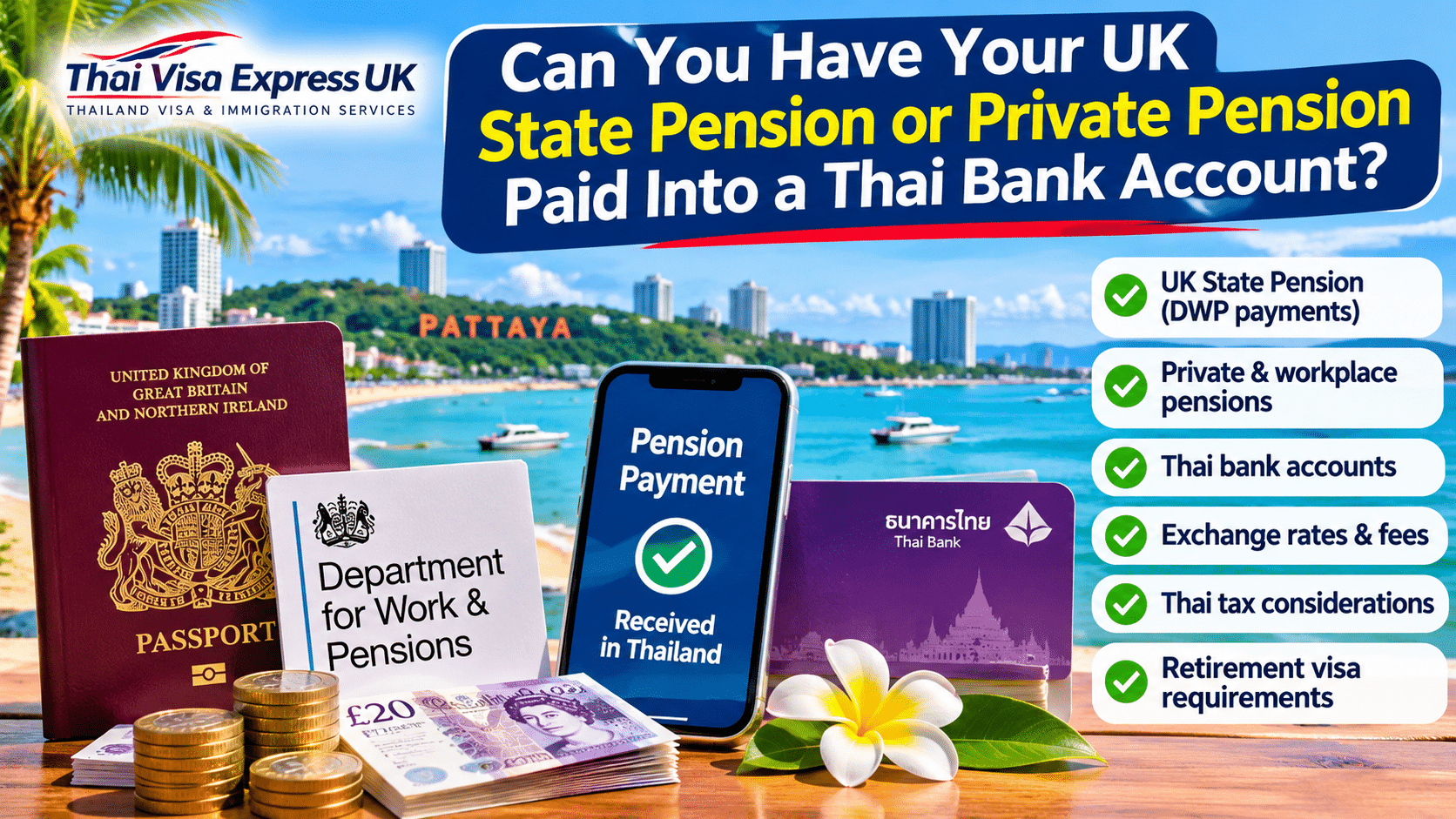
Are you retiring in Thailand and wondering whether your UK State Pension or private pension can be paid directly into a Thai bank account? The answer is yes for the UK State Pension, while private and workplace pensions depend on the arrangements offered by your pension provider.
Thousands of British nationals choose to spend their retirement in Thailand, including popular destinations such as Pattaya, Hua Hin, Phuket and Chiang Mai.
One of the most important practical decisions is how to receive your pension income and transfer money from the United Kingdom to Thailand.
This guide explains how UK State Pension payments work overseas, how private pensions can be transferred, the potential fees involved and what to consider if you intend to use pension income to support a Thai retirement visa application.
Planning to Retire in Thailand?
Our Pattaya-based team can assist with Thailand retirement visa applications, explain the financial requirements and discuss your options for using savings or pension income.
WhatsApp Our Thailand Visa TeamThai Visa Express Consultants Co., Ltd. – Pattaya, Thailand
Can Your UK State Pension Be Paid Directly Into a Thai Bank Account?
Yes. The UK Department for Work and Pensions allows eligible recipients living overseas to receive their State Pension directly into a bank account in the country where they live.
This includes Thailand.
Payments are arranged through the International Pension Centre using the International Pensions Direct Payment system.
You can generally choose to receive your State Pension:
- Into a bank account in Thailand.
- Into a UK bank or building society account.
- Every four weeks.
- Every thirteen weeks.
If you choose direct payment into a Thai bank account, the payment is normally converted from pounds sterling into Thai baht.
The amount arriving in Thailand may vary because of changes in the exchange rate.
Official information is available through GOV.UK – State Pension If You Retire Abroad.
How to Arrange UK State Pension Payments Into Thailand
If you already receive your UK State Pension, you can contact the International Pension Centre to request a change to your payment arrangements.
If you have not yet claimed your State Pension, you can provide the relevant payment details when making your overseas claim.
Step 1: Open or Confirm Your Thai Bank Account
You will need a bank account capable of receiving the relevant international pension payments.
Thai banks may require identification, proof of address and evidence of your immigration status when opening an account.
Requirements vary between banks and individual branches.
Step 2: Obtain the Correct Banking Details
The information requested may include:
- Your full name as recorded by the bank.
- Your Thai bank account number.
- The name and address of your bank.
- The bank's SWIFT or BIC code.
- Any additional routing information required by the payment service.
Thailand generally uses account numbers and SWIFT/BIC codes rather than the European IBAN system.
Step 3: Contact the International Pension Centre
Tell the International Pension Centre that you want your State Pension paid directly into your Thai bank account.
You may need to complete an International Pensions Direct Payment form and provide the requested account details.
Use the official GOV.UK overseas State Pension forms and guidance.
Step 4: Confirm Your First Payment
Check that the new arrangement has been accepted and confirm when your pension will begin arriving in Thailand.
Do not close your existing receiving bank account until the payment change has been confirmed.
Can Your UK Private Pension Be Paid Into a Thai Bank Account?
Yes, in some cases. Many British nationals living in Thailand receive income from workplace pensions, personal pensions or private retirement arrangements.
However, unlike the UK State Pension, there is no single payment system covering every private pension provider.
Some providers offer direct overseas payments, while others require pension income to be paid into a UK bank account.
Contact your pension provider before changing your banking arrangements.
What Should You Ask Your Pension Provider?
- Can regular pension payments be sent directly to a Thai bank account?
- Can payments be made in Thai baht or only pounds sterling?
- What international transfer charges apply?
- Which exchange rate will be used?
- Are there receiving-bank or intermediary-bank fees?
- What documents are required to change payment details?
- Are there any overseas residency or tax reporting requirements?
If your pension provider does not support direct payments to Thailand, you may be able to receive the pension into a suitable UK bank account and transfer the money yourself.
UK State Pension vs Private Pension Payments to Thailand
| Feature | UK State Pension | Private or Workplace Pension |
|---|---|---|
| Direct payment to Thailand | Available through DWP international payments | Depends on provider |
| Payment frequency | Every 4 or 13 weeks | Depends on scheme |
| Thai baht conversion | Normally converted to local currency | Depends on payment service |
| Charges | DWP conversion charge applies | Provider and bank charges may apply |
| Annual pension increases | Generally frozen for residents of Thailand | Depends on scheme rules |
| Tax treatment | Depends on tax residence and applicable law | Depends on pension type and tax circumstances |
How Much Does It Cost to Have Your UK Pension Paid Into Thailand?
For UK State Pension payments overseas, the Department for Work and Pensions currently specifies a currency conversion charge of 0.39% before payment.
For example, on a hypothetical £1,000 pension payment, a 0.39% conversion charge would equal £3.90.
This example is intended only to illustrate the conversion charge. The final Thai baht amount will depend on the applicable exchange rate and any other relevant banking arrangements.
Private pension transfers may involve different charges, including:
- International transfer fees.
- Currency conversion margins.
- Intermediary banking fees.
- Thai receiving-bank fees.
Always compare the final amount received in Thai baht rather than looking only at the advertised transfer fee.
Is It Better to Receive Your Pension in a UK Bank or a Thai Bank?
Both options have advantages.
Receiving Your Pension Directly Into Thailand
Direct payment can be convenient for people who permanently reside in Thailand and regularly use Thai baht for their living expenses.
Advantages may include fewer manual transfers and predictable arrangements for receiving retirement income.
However, currency conversion occurs when the pension is paid, and the sterling-to-baht exchange rate can fluctuate.
Receiving Your Pension Into a UK Bank
Keeping your pension payments in a UK account may offer more flexibility over when and how much money you transfer to Thailand.
This can be useful if you maintain expenses in the UK or prefer to manage international transfers yourself.
However, UK banks have different policies on accounts held by non-residents, so you should confirm your bank's position before relocating.
There is no single arrangement that suits every British retiree.
Will Your UK State Pension Be Frozen in Thailand?
Yes, generally. British nationals who ordinarily reside in Thailand do not receive the normal annual increases to their UK State Pension.
This is commonly known as a frozen UK State Pension.
Although the UK State Pension may increase each year for eligible pensioners living in the UK and certain other countries, those annual increases are not generally payable while living in Thailand.
Your private or workplace pension may have different annual increase provisions depending on the rules of your particular scheme.
For official information, see How Your UK State Pension Is Affected When Living Abroad.
Can UK Pension Income Be Used for a Thailand Retirement Visa?
Potentially, yes. UK pension income can be relevant when demonstrating sufficient finances for a Thai retirement visa or one-year retirement extension.
For the standard annual retirement extension, one recognised financial route requires qualifying income of at least 65,000 THB per month.
However, the financial evidence accepted by Thai Immigration depends on the relevant application route and immigration office.
Regular pension deposits into a Thai bank account do not automatically guarantee that the applicant meets the income evidence requirements.
Applicants should confirm what bank statements, pension evidence, income certification or international transfer records will be accepted.
What If Your Pension Is Less Than 65,000 Baht Per Month?
There may be alternative financial arrangements.
One common option for eligible applicants is the 800,000 THB Thai bank deposit method, subject to the required account balance and timing conditions.
A combination of income and savings may also be possible where the applicable immigration rules and evidence requirements permit.
Receiving a pension is not universally necessary for the standard annual retirement extension when the applicant meets the bank deposit requirements.
Read our detailed guide:
Can You Get a Thai Retirement Visa Without a Pension?
This explains the savings route, financial requirements and the difference between an initial Non-O visa and an annual retirement extension.
Do You Need a Thai Bank Account for Your Retirement Visa?
A qualifying Thai bank account is generally required if you intend to rely on the 800,000 THB bank deposit method for a retirement extension.
The account must satisfy the applicable immigration rules, including the required minimum balances and deposit maintenance periods.
Receiving pension income directly into a Thai account may help create an identifiable banking history, but does not automatically establish that the income method has been satisfied.
Before making changes to your payment arrangements, consider both your banking requirements and your intended immigration application route.
Should You Bring Cash From the UK or Transfer Money to Thailand?
Some British nationals relocating to Thailand consider bringing cash with them rather than transferring funds electronically.
Although carrying cash is possible within the applicable declaration requirements, moving substantial amounts of money internationally can involve customs, security and documentary considerations.
Bank transfers may provide a clearer record of the source and movement of funds, which can be relevant when dealing with Thai banks and immigration applications.
If you are planning to bring British pounds into Thailand, read our separate guide:
Bringing Cash From the UK to Thailand – How Much Can You Carry?
This explains the relevant cash declaration considerations for travellers leaving the UK and entering Thailand.
Will You Pay Thai Tax on Your UK Pension?
This is an important consideration for British nationals who spend substantial periods of the year in Thailand.
Under Thai tax residency rules, a person who spends 180 days or more in Thailand during a calendar year may be treated as a Thai tax resident.
Thai tax residents can be subject to Thai personal income tax on qualifying foreign-source income remitted into Thailand.
The treatment of UK State Pensions, private pensions and workplace pensions depends on the nature of the income, when it arose, the individual's tax residence and the relevant tax rules.
Thailand's foreign-source income rules introduced from 2024 are particularly important when considering remittances of income earned from that date onward.
The UK and Thailand also have a double taxation agreement, which may affect how particular pensions are taxed and whether relief is available.
Government service pensions can be subject to different treaty provisions from ordinary private pensions.
Official references include:
- Thailand Revenue Department – Personal Income Tax
- HMRC – Tax on Pensions When Living Abroad
- UK–Thailand Double Taxation Convention
How Thai Visa Express Can Help With Retirement in Thailand
Thai Visa Express Consultants Co., Ltd. is based in Pattaya, Chon Buri, Thailand.
We assist British nationals considering retirement in Thailand, including people who receive a UK State Pension, private pension or intend to rely on qualifying savings.
Our retirement visa assistance includes guidance on the applicable immigration requirements, supporting documents and relevant stages of the retirement visa application process.
Our standard advertised Non-O retirement visa assistance package is 45,000 THB per person, covering the initial Non-O visa and subsequent one-year extension service stages as described in our service package.
The applicant's required bank deposit is separate from the professional service fee.
Eligibility and the appropriate initial visa route must be assessed before proceeding, and visa approval cannot be guaranteed.
For full details, visit our Thailand Non-O Retirement Visa Service.
Frequently Asked Questions
Can my UK State Pension be paid directly into a Thai bank account?
Yes. The UK Department for Work and Pensions permits State Pension payments into eligible overseas bank accounts, including accounts in Thailand.
Can I have my private pension paid directly into Thailand?
Potentially. This depends on the policy and payment facilities of your pension provider. Some support direct international payments, while others may require payments into a UK account.
Will my UK State Pension be paid in Thai baht?
When paid directly into a Thai bank account under the DWP international payment arrangements, the pension is normally converted into local currency.
How often can I receive my State Pension in Thailand?
You can generally choose payments every four or thirteen weeks under the overseas State Pension arrangements.
Will my UK State Pension increase each year if I live in Thailand?
Generally not. Thailand is among the countries where UK State Pension payments do not normally receive annual uprating while the pensioner is ordinarily resident there.
Can I use my UK pension to meet the 65,000 baht retirement visa income requirement?
Potentially, provided the income qualifies and you can supply the evidence accepted by the relevant Thai immigration authority. Receiving regular transfers does not by itself guarantee acceptance.
What if my pension is below 65,000 baht per month?
You may be able to qualify using the 800,000 THB Thai bank deposit method or another permissible financial arrangement, subject to the applicable rules.
Will I pay tax in Thailand on my private pension?
Possibly. Your Thai tax residency, the type of pension, the timing of the income and remittance, and the UK–Thailand tax treaty can all affect the outcome. Individual tax advice is recommended.
Can Thai Visa Express help with a retirement visa?
Yes. Our Pattaya team provides retirement visa application assistance and can explain the financial evidence required for your intended immigration route.
Moving to Thailand With a UK Pension?
Whether you receive a State Pension, private pension or intend to use savings, contact our Pattaya team to discuss your retirement visa options.
WhatsApp Thai Visa Express Pattaya Thai Visa Express Consultants Co., Ltd.
Pattaya, Chon Buri, Thailand
WhatsApp: +66 80 102 2328
Related Thailand Retirement Guides
- Can You Get a Thai Retirement Visa Without a Pension?
- Bringing Cash From the UK to Thailand – How Much Can You Carry?
- Thailand Non-O Retirement Visa – Application Assistance
- Thailand Non-O-A Retirement Visa – Health Insurance Requirements
- Thailand Non-O-X Visa – Long-Stay Retirement Options
Information reviewed: November 2026. This article provides general guidance, not regulated financial or individual tax advice. Pension provider arrangements, tax legislation and immigration requirements can change. Confirm payment arrangements directly with the Department for Work and Pensions or your pension provider. Immigration applications remain subject to the requirements and decisions of the relevant Thai authorities.