Have you received your Thai Non-Immigrant O (Non-O) e-Visa and want to know when your 90-day stay begins? One of the most common misunderstandings is that the 90-day stay starts as soon as the Embassy issues the visa. For a standard single-entry Non-O e-Visa, that is not how it works.
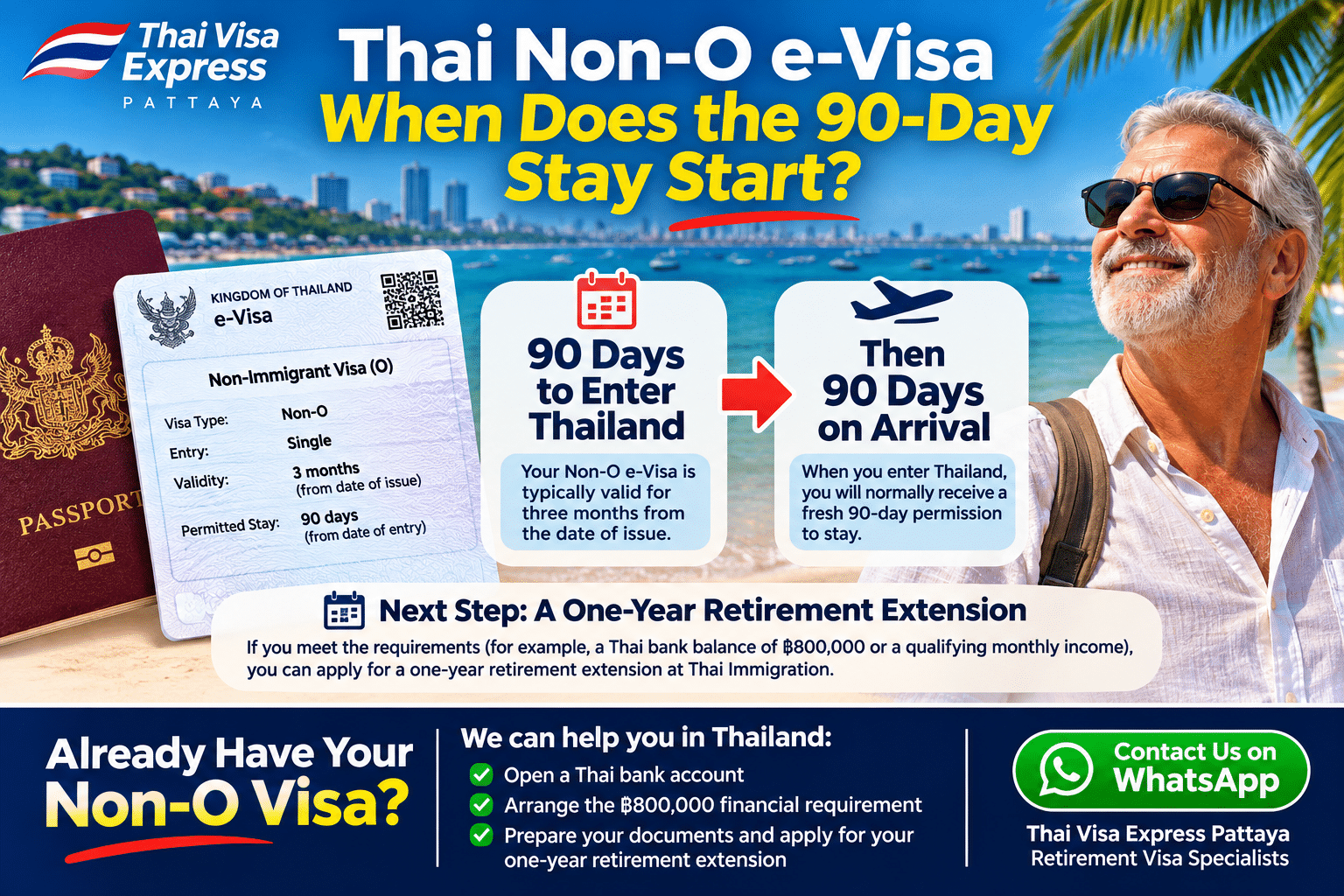
You generally have three months from the date of issue to enter Thailand. When you enter Thailand using the visa, Immigration normally grants a fresh permission to stay of up to 90 days from arrival. The date printed on your e-Visa and the date stamped into your passport have different purposes.
What Is the Difference Between Visa Validity and Permission to Stay?
Visa validity is the period in which you can use the visa to enter Thailand. A standard single-entry Non-O visa issued by the Royal Thai Embassy in London is normally valid for three months from issue. You must arrive before the expiry date shown on the visa.
Permission to stay is the period Thai Immigration grants you when you enter the country. For a standard Non-O entry, that is normally up to 90 days. Your permitted-until date is shown in your entry stamp or official immigration record.
Example: Non-O e-Visa Issued in November
Suppose your single-entry Thai Non-O e-Visa is issued on 4 November. The visa will normally show an entry-validity deadline approximately three months later, in early February. You do not need to arrive immediately.
If you enter Thailand in January, while the visa remains valid, you would normally receive a new permission to stay of up to 90 days starting from that January arrival. The precise date you are allowed to remain until is determined by the Immigration officer and the permission recorded on entry.
You do not lose your 90-day stay merely because you waited several weeks after the e-Visa was issued before travelling.
Do You Have to Enter Thailand Within 90 Days of the Visa Being Issued?
The Embassy's usual wording is three months of visa validity, rather than a guarantee of exactly 90 days. Check the e-Visa's valid until date and make sure you enter Thailand while it is still valid.
Do not confuse this with the separate 90-day stay normally granted after arrival. If the visa expires unused, you cannot rely on it for entry; you may need a new application.
Need Help With Your Thai Non-O Visa?
Thai Visa Express Pattaya assists eligible UK applicants with the initial Non-O e-Visa and can help plan the retirement extension stage after you arrive in Thailand.
WhatsApp Our Thailand Visa TeamThai Visa Express Consultants Co., Ltd. | Pattaya, Thailand
Already Have Your Non-O Visa? We Can Help With the Next Stage in Thailand
If your Non-O visa has already been issued, or you have arrived in Thailand and intend to retire here, you may need help organising your Thai bank account, financial evidence and application for a one-year retirement extension.
Thai Visa Express Pattaya can assist eligible retirement applicants with:
- Thai bank-account opening assistance, including guidance on bank and branch documentation requirements.
- Planning and arranging support for the ฿800,000 financial requirement, with the applicable funding arrangement and immigration evidence explained and agreed in writing before proceeding.
- Obtaining bank letters, statements and other supporting documents, where applicable.
- Preparing and submitting a one-year retirement extension application to the relevant Thai Immigration office.
- Assistance with a multiple re-entry permit if you need to travel outside Thailand after your extension.
Whether you need just the in-country stage or assistance with the initial visa and retirement extension together, our team can assess your circumstances and explain the service options.
What Financial Requirements Apply to a One-Year Retirement Extension?
Applicants for a retirement extension are generally aged 50 or over, hold an eligible non-immigrant status, and meet one of the financial routes accepted by Thai Immigration. Common routes include:
| Financial Route | Typical Requirement |
|---|---|
| Thai bank deposit | At least ฿800,000 in an eligible Thai bank account for the required period, with continuing minimum-balance rules. |
| Monthly income | Qualifying evidence of at least ฿65,000 per month. |
| Combination | An eligible combination of income and bank funds meeting the relevant annual threshold, subject to Immigration's evidence rules. |
Under the usual bank-deposit route, the ฿800,000 balance must generally be maintained for at least two months before applying and three months after approval. The account must then normally remain at no less than ฿400,000 during the rest of the year, with the higher balance restored in time for the next application.
Evidence for the initial e-Visa and a later extension in Thailand is not interchangeable. Our Pattaya team can explain the practical steps and the requirements relevant to your local Immigration office.
Can Your UK State Pension or Private Pension Be Paid Into a Thai Bank Account?
Yes. Eligible UK State Pension recipients can arrange payment into a bank account in Thailand. Payments from private and workplace pensions may also be possible, depending on the pension provider's arrangements.
A Thai bank account can make day-to-day retirement finances easier, but a pension payment into Thailand does not automatically prove that you meet Thai Immigration's income route. The required evidence and any transfer-history conditions must be checked.
For payment options, banking considerations and pension-transfer information, read our detailed guide: UK State & Private Pension Payments to Thailand .
Can You Extend a Non-O Visa for One Year in Thailand?
Eligible Non-O holders may apply for a separate one-year extension of stay based on retirement. This is not automatic and must be applied for in Thailand before your existing permission to stay expires, within the local Immigration office's permitted application period.
With a standard 90-day initial stay followed by an approved one-year retirement extension, an applicant may have approximately 15 months of permission to stay from their initial arrival, subject to the actual dates granted. The original visa does not itself grant a 15-month stay.
Read about our Thailand Non-O retirement visa and extension assistance , or see our Non-Immigrant O visa guide for more background.
What Happens if You Leave Thailand During Your 90-Day Stay?
A single-entry visa is normally used when you enter Thailand. If you leave Thailand without a valid re-entry permit, you may lose the remainder of your existing permission to stay. A re-entry permit can protect an existing permission to stay, but it does not extend its expiry date.
If you expect to travel abroad during your retirement, discuss your plans with us before leaving Thailand.
Thai Non-O e-Visa Validity: Frequently Asked Questions
Does the 90-day stay begin when my e-Visa is approved?
No. The entry-validity period starts when the visa is issued, but the permitted stay normally begins when you enter Thailand using the valid Non-O visa.
Can I arrive two months after my Non-O visa is issued?
Normally yes, provided the visa is still valid on your date of entry. You would usually receive up to 90 days of permission to stay from arrival. Always check the visa expiry date and the entry stamp.
Do I get another 90 days every time I enter?
Not with a standard single-entry Non-O visa. It allows one entry. Additional entries or permission to stay require the correct immigration arrangements.
Can Thai Visa Express open a bank account for me?
We can provide practical assistance with the Thai bank-account opening process. The bank decides whether to open the account and what evidence you need.
What if I already have my Non-O visa but need help with the ฿800,000 requirement?
Contact our Thailand team. We can assess your retirement-extension plans and explain available support with banking, financial documentation and the required immigration process. Any funding arrangements must comply with the relevant rules and be agreed in writing.
Is a Non-O visa the same as a Non-O-A retirement visa?
No. The Non-O-A is a separate long-stay retirement visa category with different application and health-insurance requirements. See our Non-O-A visa and health insurance guide .
Already Have a Non-O Visa? Speak to Our Pattaya Team
Tell us your age, nationality, date of arrival and the permitted-until date on your immigration stamp. We can assess your options for a Thai bank account, the retirement financial requirements and a one-year extension.
WhatsApp Thai Visa Express PattayaThai Visa Express Consultants Co., Ltd. | Pattaya, Chonburi, Thailand | +66 80 102 2328
Official guidance: Royal Thai Embassy London - Non-Immigrant Visas and Thai Government - Retirement Extension Requirements .
Information notice: This guide concerns the usual single-entry Non-O route, particularly retirement applicants. Family and other Non-O categories can have different conditions. Requirements can change, and visa issuance, bank-account opening and extensions remain subject to the relevant authorities. Thailand visa services are provided by Thai Visa Express Consultants Co., Ltd., a separate Thailand-based company, not regulated by the UK Immigration Advice Authority.