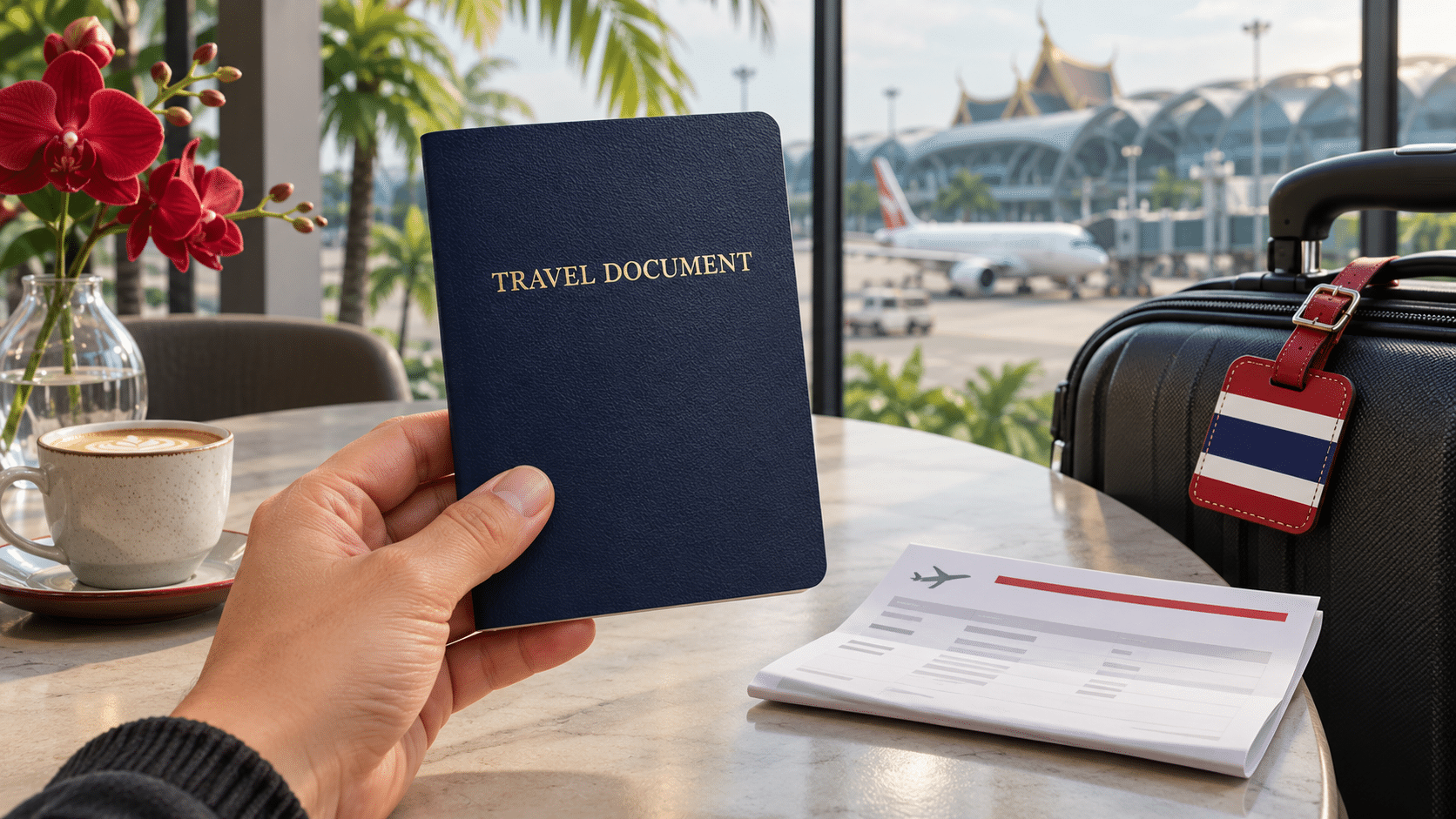
Thailand immigration rules for UK citizens are important whether you are planning a holiday, returning several times a year or preparing to retire in Thailand. Entry conditions depend on your passport, purpose of travel, visa (if required) and the immigration officer's decision.
This guide explains the current visa-exemption rules, Thailand Digital Arrival Card (TDAC), tourist e-Visas, repeated visits, extensions of stay, Non-O retirement visas and other common immigration requirements.
Important update: From 15 September 2026, eligible British passport holders entering Thailand under the tourist visa-exemption scheme are normally permitted to stay for up to 30 days, rather than the previous 60 days. Check the permitted-until date given by Thai Immigration when you arrive.
Need help choosing the right Thailand visa?
Tell our Thailand team your nationality, previous visits, intended arrival date and how long you want to stay. We can explain the visa services that may suit your plans.
Chat with Thai Visa Express on WhatsApp1. What do Thai immigration officers check when you arrive?
An immigration officer at an airport or land-border checkpoint may examine your travel documents, previous visits and intended activities. Be prepared to provide:
- A valid passport and the correct visa, if one is required.
- Details of where you will stay in Thailand.
- Onward or return travel appropriate to your permission to enter.
- Evidence that you have sufficient funds for your visit.
- Confirmation that you have submitted your Thailand Digital Arrival Card (TDAC).
Frequent arrivals or lengthy previous stays may lead to further questions. A visa does not guarantee admission: the final decision rests with Thai Immigration.

2. Can British citizens enter Thailand without a visa?
Ordinary British passport holders visiting Thailand for eligible tourism purposes can generally use the 30-day visa-exemption scheme. This is different from a Visa on Arrival: visa exemption means you do not need to obtain a tourist visa in advance for an eligible short visit.
Thai authorities may ask visa-exempt travellers for proof of accommodation, funds and onward travel departing Thailand within the permitted period. Tourism visa exemption does not cover work or other activities requiring a different immigration category.
Land-border rule: For eligible travellers, visa-exempt entry through land-border immigration checkpoints is normally limited to two entries per calendar year. That numerical restriction does not generally apply to air arrivals, but frequent air travel can still be scrutinised.
Planning a longer visit? Read Thailand Holiday Longer Than 30 Days – Your Visa Options.
3. Visited Thailand several times in the last 12 months? Consider a Thai e-Visa
If you have visited Thailand on multiple occasions within the past 12 months, consider applying for an appropriate Thai e-Visa before your next trip instead of continually relying on visa-exempt entry.
Several lengthy stays, back-to-back arrivals or repeated short trips out of Thailand can lead immigration officers to question whether you are genuinely visiting as a tourist or effectively living in Thailand without the appropriate status.
Depending on your circumstances, an appropriate option may include:
- Single-entry tourist e-Visa for one longer holiday.
- Multiple-entry tourist e-Visa for eligible travellers making genuine repeat tourist visits.
- Non-Immigrant O visa for qualifying retirement or family circumstances.
- Another long-stay visa category if your actual purpose is not ordinary tourism.
There is no universal rule that three or four visits in 12 months automatically require an e-Visa. Your pattern and purpose of travel matter. An approved visa does not erase your previous travel history or guarantee entry.
Explore our Thailand single-entry and multiple-entry tourist visa guide or Thailand visa application services for UK residents.
4. Thai e-Visa, Visa on Arrival and TDAC: what's the difference?
- Thai e-Visa: an application made online for the appropriate visa category before travelling.
- Visa on Arrival: a separate visa arrangement for specified nationalities. Ordinary British tourists generally use visa exemption for eligible short stays instead.
- Thailand Digital Arrival Card (TDAC): an electronic arrival declaration, not a visa.
See our dedicated comparison: Thai e-Visa, Visa on Arrival and TDAC Explained.

5. Do you need to complete the Thailand Digital Arrival Card?
Most foreign travellers entering Thailand must complete the free Thailand Digital Arrival Card (TDAC) within the three-day period before arrival, including the day of arrival. It applies to eligible visa-exempt travellers and holders of Thai visas and must be completed for each new entry, subject to any official exceptions.
Submit it at the official Thailand Digital Arrival Card website. The TDAC is free and does not replace the need for a visa where one is required.
6. Staying longer than 30 days: tourist visas and extensions
If you are planning a holiday longer than the visa-exempt allowance, review your options before flying. A standard single-entry tourist visa commonly allows a stay of up to 60 days from arrival. Eligible visitors may be able to apply to a Thai immigration office for a further extension.
A tourist extension commonly involves form TM.7 and a government application fee of 1,900 THB. An extension of up to 30 days may be granted to eligible applicants, but this is at the immigration officer's discretion.
Do not assume an extension will be approved when making airline bookings. For a practical overview, read our guide to Thailand holidays longer than 30 days.
7. Proof of Funds at Thai Immigration
Thai immigration officers may request proof of sufficient funds for your stay. Official guidance is not uniform across every visa and entry category: the Royal Thai Embassy in London says officers may ask visa-exempt visitors for 20,000 THB per person, while UK government travel guidance gives a lower illustrative amount for some entry checks. To avoid difficulties, check the conditions applying to your own entry category and carry sufficient accessible funds.
Do not assume a bank card by itself will satisfy an officer asking to see cash or equivalent proof of funds.
8. Non-O retirement visas and one-year extensions
If your real intention is to retire in Thailand, repeated short tourist entries may not be appropriate. Eligible applicants may consider a Non-Immigrant O visa obtained before travelling and, where the conditions are satisfied, a separate retirement extension of stay after arrival.
A qualifying initial Non-O visa commonly allows up to 90 days in Thailand. A subsequent one-year retirement extension is a separate application subject to immigration rules, financial evidence, residence information and timing requirements. The initial visa does not guarantee that an extension will be approved.
See our Thai Non-O visa guide.
Do you need a return ticket when entering on a Non-O visa?
If you plan to enter on a Non-O visa and apply for a retirement extension, your travel plans differ from a visitor taking a short holiday. Airlines and immigration authorities may still check your documents. Read Do You Need a Return Ticket with a Thai Non-O Visa?
9. 90-day reporting and TM30 accommodation notifications
Foreigners who stay in Thailand for more than 90 consecutive days generally need to complete 90-day address reporting unless an exception applies. This is an address notification, not an extension of your visa or permission to stay. Travel outside Thailand may affect the next reporting date.
TM30 is a separate accommodation reporting requirement generally associated with the person responsible for where a foreign national stays, such as a hotel operator or property owner. Local immigration offices may request accommodation evidence when dealing with extension applications.

10. Leaving Thailand: re-entry permits
If you have an extension of stay and intend to leave Thailand temporarily, check whether you need a re-entry permit before departure. A suitable permit can preserve the existing permission to stay when you return within its validity; it does not give you a fresh one-year permission or extend the original expiry date.
A multiple-entry visa and a multiple re-entry permit are different documents. Make sure you understand what you currently hold before travelling.

11. Overstaying or being refused entry
Check the permitted-until date in your passport or immigration record. Overstaying can result in fines, detention, deportation or re-entry bans. Repeated attempts to live in Thailand on tourist entry permissions may also raise questions about the genuine purpose of your travel.
If you have previously overstayed or been refused entry, seek advice about the correct visa category before arranging another trip.
Thailand immigration FAQs for British travellers
Can I visit Thailand several times in one year?
Genuine repeat tourism is possible, but individual entry decisions depend on your travel history and purpose. The usual visa-exempt land-border limit differs from the position for arrivals by air. Multiple lengthy tourist stays may attract scrutiny.
Will a Thai e-Visa guarantee entry?
No. An approved visa does not remove an immigration officer's authority to assess your entry at the border.
Can I apply for a Thai e-Visa while already inside Thailand?
No. Thai e-Visa applications must be made while the applicant is outside Thailand, and the embassy or consulate accepting the application may have additional residence and physical-location requirements.
Is the TDAC a visa?
No. It is a free electronic arrival declaration and does not replace a required visa.
Does a 90-day Non-O visa automatically become a one-year retirement visa?
No. Any annual retirement extension requires a separate application and approval by Thai Immigration.
Planning another visit or a longer stay in Thailand?
If you have made several visits in the past year, want to stay longer or are considering retirement in Thailand, ask our Thailand team about a suitable visa application service.
Ask Our Thailand Team on WhatsAppOr see our Thailand Visa Services for UK Residents.
Official sources and further information
- Royal Thai Embassy London – Visa Exemption and Visa on Arrival
- GOV.UK – Thailand Entry Requirements
- Official Thailand e-Visa portal
- Official Thailand Digital Arrival Card
Last reviewed: 7 November 2026. This article provides general information, not an assurance of visa approval or entry. Immigration requirements can change. Thailand visa services are provided by Thai Visa Express Consultants Co., Ltd., a separate Thailand-based company, and are not regulated by the UK Immigration Advice Authority (IAA).